Looking over my sizable collection of DVDs...amongst the
dramas, comedies, musicals, thrillers, adventures, horror films, and even
documentaries, I note there to be a conspicuous paucity of four distinct genres
of film: war movies, sports films, westerns, and science fiction. I’ve really not a single
war film (Doctor Zhivago coming
closest); only one western - the original True Grit, unless you count Doris Day’s Calamity Jane; and sports weigh in exclusively with Martin Scorsese’s Raging Bull. My sole concession to the
field of science fiction is François Truffaut’s flawed, but nonetheless splendid adaptation of Ray Bradbury’s Fahrenheit 451. One of the very few science fiction films I really enjoy, perhaps due to the fact that it was made by a man who had gone on record
as not being particularly fond of science fiction films himself.
Julie Christie as Linda Montag
Oskar Werner as Guy Montag
Julie Christie as Clarisse McClellan
Cyril Cusack as The Captain
Anton Diffring as Fabian
Ray Bradbury’s ingenious novel about a future society where reading is forbidden, books are banned, and marauding herds of fascist “firemen” canvass the countryside in search of books to burn is sci-fi light. Its setting is futuristic, but technology plays into it in the most mundane, everyday ways. What speaks to me most vividly is the story's overall concept and its vision of a world distrustful of thought.
There are just some ideas that, to me, are simply
irresistible in their cleverness. Ira Levin achieved this twice: once with the
idea of a thriving Satanic Coven in modern Manhattan overseen by a bunch of
little old ladies and gentlemen (Rosemary’s Baby); a second time with a suburban community populated by ideal wives,
all of whom, in actuality, are robots (The Stepford Wives). The concept of a world in which firemen are paid and trained to start fires strikes me as pure genius. It’s a sharp and concise idea that lends itself to all manner of dramatic possibilities and opportunities for social commentary.
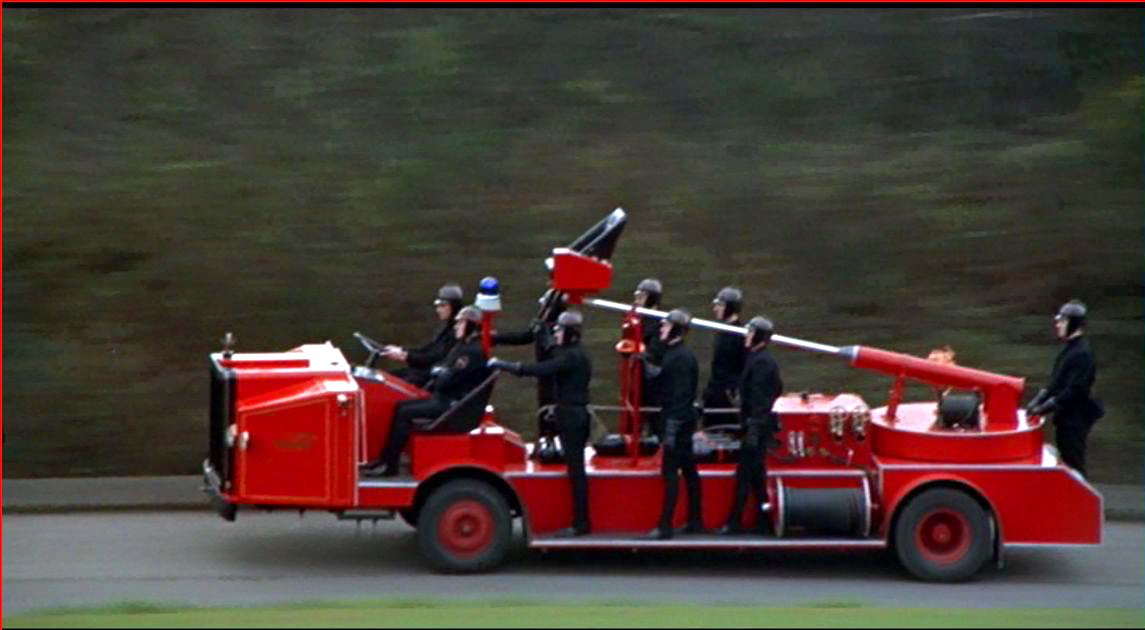
The Fireman of Fahrenheit 451, on their way to a book burning
Fahrenheit 451 is a
standout work of literature, but as much as I love the book and as fond as I
am of the film, I find I enjoy both most when I leave off trying to compare the two. It’s best not to look to Truffaut’s
adaptation for faithfulness to the original text, nor is it worthwhile to
ruminate on the possible improvements to Bradbury’s prose introduced by
Truffaut’s articulate mastery of the language of cinema. Both are enormously entertaining
and thoughtful works capable of being enjoyed as free-standing, independent
narratives with slightly differing objectives.
Bradbury’s book is a political allegory,
more sociological in bent, commenting on the dangers of censorship and threats
to independent thought. Truffaut’s film is more personal in scope. Something akin to being the literary companion to both his 1973 valentine to the movies: Day for Night, and his 1980 paean to theater: The Last Metro, Truffaut’s Fahrenheit
451 speaks to the filmmaker’s love of books and reading. It's not so much a sci-fi film as a Grimm fairy tale about a nowhere man who finds himself by getting lost in the written word.
By the light of his big-screen TV, Montag reads his first book - Dickens' David Copperfield. An unexpected perk of seeing this film today is noticing how many of Ray Bradbury's predictions for the future (Reality television, wall-sized TVs, earbuds, anti-intellectualism, a disdain for literature, the rise of fascism) have come to pass.
I derive great pleasure from both artists' approach to the material, and I find that focusing on the many ways the film deviates from Bradbury’s themes or corrupts the author’s intentions is a perfect way to court frustration and blind oneself to the unique pleasures of Truffaut’s film.
The Book Lady Montag finds his beliefs shattered and the course of his life altered when he encounters an old woman (Bee Duffell), a lifelong book hoarder who would rather die than live without books.
"Fahrenheit 451" opened in New York on Monday, November 14, 1966, at the Plaza Theater.
WHAT I LOVE ABOUT
THIS FILM
Perhaps my favorite thing about Fahrenheit 451 is Truffaut’s dogged
resistance to meeting and satisfying the genre expectations of science fiction. In a
1970 interview with film critic Charles Thomas Samuels, Truffaut expressed his
disinterest in science fiction and claimed to have felt no affinity for the
novel’s political metaphor. Truffaut chose instead to construct an allegory
about a closed-off, dissatisfied man who comes to fall in love with life,
mankind, and himself when he embarks on an epiphanic discovery of books and
reading. For me, this is a brilliant tactic on Truffaut's part, one which may have disappointed many fans of the novel, but saves Fahrenheit 451 from being just another sci-fi film with socio-political subtext. Truffaut's disinterest in politics increases the human interest in Bradbury's story in much the same way Roman Polanski's agnosticism helped bring a stronger emotional/psychological emphasis to Rosemary's Baby.
In the visual, hyper-literal language of film, I think it would have been unwise to emphasize the political elements of Fahrenheit 451 that are so clearly stated, underlined, and emphasized in the plot itself. Truffaut avoids overstatement and didacticism by letting the film’s agenda regarding fascism, repression, and censorship play out in the background…reserving his foreground focus for the characters and the human drama.
Family
State
Self
PERFORMANCES
Fahrenheit 451 marks
my 6th post for a Julie Christie film, so by now, most visitors to
this blog know the drill: a brief introduction to the character followed by a
paragraph or two of gushing, fawning, thoroughly over-the-top (yet not unwarranted) admiration for the iconic sixties actress. All unencumbered by neutral, objective appraisal. And as Christie assays a dual role in Fahrenheit 451 (Time Magazine-
“…it strongly supports the widely held suspicion that [Julie Christie] cannot
actually act. Though she plays two women of diametrically divergent
dispositions, they seem in her portrayal to differ only in their hairdos"), it
affords twice the opportunity for unbridled fandom.
I'll make it brief. Cinematographer Nicolas Roeg, working with Christie for the first time (they would collaborate several more times in the future), makes her look positively stunning no matter which character she plays. Lastly, she's a major asset to the film and its lifeblood, despite never really getting as strong a grasp on the Clarisse role as on Linda...a character who has more than a few things in common with Darling's Diana Scott.
Cyril Cusack is charming, paternal, and ultimately terrifying as the doctrine-spouting Chief of firemen.
Christie plays both Linda Montag, the superficial,
self-absorbed wife of fireman Guy Montag, and Clarisse, the inquisitive,
rebellious schoolteacher who inspires Guy to examine his life. Of course, I
think Christie is fabulous in both roles chiefly because she doesn't engage
in over-broad, showy acting devices delineating the two characters - something audiences at the time faulted her for, but which seems to me to be an authentic realization of Truffaut's overall concept. I saw Fahrenheit 451 many
years before reading the book, and I must say that the impression I got from
Julie Christie appearing in dual roles was that Truffaut was offering audiences the visual similarity between Clarisse/Linda as an external manifestation of Montag’s inner perspective.
Linda and her mirror double (Clarisse?) confront Montag about reading books, which is forbidden. Tellingly, the challenging Linda remains physically estranged from her husband, while her double seems to stand in solidarity with Montag in his defense of thinking and feeling. The very things Clarisse believes in and fights for.
By this, I mean that I've never taken it as a literal fact that two complete strangers in Montag's life are perfectly identical women. Rather, I've always held the belief that only Montag sees them as identical. Montag
responds to the similarities between Clarisse and Linda (“She’s rather like you, except her hair
is long”) and sees them as twin halves of the same person. The intellectual and
spiritual/the unimpassioned and superficial. This is, however, not consistent with Bradbury’s
vision. In the book, Clarisse is a teenager and different from Linda in every way...but the duality fits Truffaut's more personality-based interpretation of Fahrenheit 451. I like to think that the
Clarisse and Montag we see at the end of the film are a vision of what Linda and
Guy were before their senses and passions were dulled by suppression and conformity.
Fueling my theory that much of Fahrenheit 451 deals in intentional ambiguity and concepts of duality is the brief scene where a spying schoolmistress looks like (is?) Montag's nemesis, Fabian (Anton Diffring).
THE STUFF OF FANTASY
Fahrenheit 451 is marvelously devoid of the usual futuristic hardware fetish I find so stultifying in most science fiction movies. The film presents futuristic progress as boring, workaday, and banal, which is somehow always what seems to happen with technology in real life. The fact that the internet—the most revolutionary invention for the gathering and sharing of information—is chiefly used as a tool for bullying, bickering, and pornography is proof enough that technology always surrenders to the inalienable fact that people obstinately remain no more than human in the face of the most incredible technological advances.
The Narcissists I don't recall whether it was in the book, but Truffaut suggests sensual narcissism as a kind of side effect of a technological society that discourages people from interacting and thinking. Throughout the film, people are glimpsed absent-mindedly stroking, kissing, or caressing themselves. Certainly, the current mania for self-involved social media, selfies, and online over-sharing can be seen as the ultimate real-life actualization of Truffaut's hinted-at phenomenon of self-absorption.
This is Truffaut's first color film, and he makes great use of the gloomy countryside locations, contrasting them strikingly with eye-popping, Kubrick-red interiors and crimson fire imagery. On a side note, what would this film be without the music of Bernard Herrmann? Beautiful, sweeping themes that remind me very much of Vertigo.
THE STUFF OF DREAMS
At the start of this essay, I stated that I think Fahrenheit 451 is a splendid but flawed Truffaut
effort. Its chief flaw, as I see it, is that a film about people benumbed and rendered passionless due to the oppressiveness of a totalitarian society risks being the very thing it hopes to dramatize. In reference to the 1996 film Fargo, a critic (Pauline
Kael, perhaps) made the very good point that even an excellent movie about moronic people is
still ultimately a film about moronic people, and therefore one not easily endured, no matter its proficiency.
Francois Truffaut envisions a future in which hyper-technology lives quaintly alongside the old-fashioned (antique telephones, oil lamps). Here, Montag is gifted a straight razor by his wife ("It's the very latest thing!") and encouraged to ditch his old-fashioned cordless electric razor.
François Truffaut (who didn't speak English and whose first
and only English-language film this is) does a great job of finding photogenically bland, cold landscapes in which to play out his drama, and he takes some real chances in intentionally asking for stilted, sometimes robotic
performances from his actors. While all of this is consistent with the story's theme, it
is deadly to entertainment. If Fahrenheit
451 suffers at all, it is from a lack of blood coursing through its veins.
In focusing so effectively on the aspects of the plot that demonstrate the spiritually deadening effects of an oppressive society, Truffaut fails to find a satisfactory way to convey what is at stake and what stands to be lost when people are deprived of the freedom to think. Without some sense of life's vitality expressed somewhere on the screen, there seems to be something elemental missing from the depiction of the life-changing effect books and reading can have on the human spirit.
Clip from "Fahrenheit 451" (1966)
But I’m a sucker for movies about
emotional and spiritual transformations (virtually ANY version of A Christmas Carol can easily reduce me
to tears by the end), so I find myself moved—perhaps unaccountably so, given
the film’s cool presentation—by the awakening of Guy Montag to the miracle of
books. Oskar Werner's scenes of Montag discovering the written word, particularly the sequence in which he tries to make sense of a woman who'd rather die than be separated from her books, are sensitively rendered and unexpectedly moving.
Montag finds his bliss
As a teen, I retreated into books as a means of coping with my crippling shyness. As an adult, I'm happy that my one-time escapist immersion in the written word has blossomed into an appreciation for how books expand one’s world. I love libraries, old bookstores, and the heft, weight, and texture of books. So much so, in fact, that I don’t know if I’ll ever be able to surrender to the practicality of e-books and electronic readers. While on that topic: there is something very Ray Bradbury-ish about naming an electronic device (one poised to replace books and paper-printed literature) a Kindle and Kindle Fire. I understand the name is intentional, but, boy!... in these anti-intellectual times, talk about Bradbury’s book-burning future coming to pass!
The weird thing about sexual repression is how it creates, then proceeds to foster and perpetuate, the atmosphere of shame and sin it purports
to be on guard against. Case in point: so-called "family" entertainment.
Rodgers & Hammerstein's Oklahoma! (1955) is the dirtiest movie I ever saw. Really. This
corn-fed ode to spring, sparkin', and spoonin' is nothing but a wall-to-wall
smut-fest obsessed with fornication. Or, fornicatin' as the characters
themselves would probably drawl, were the film able to stop being so coy and
wholesome for five minutes and just lay out on the table what is obviously its sole
purpose, preoccupation, and focus. For nigh on 2 ½ hours (dialect helps to get
into the spirit of things), horny farmhands in tight jeans and overheated farmer's
daughters in calico dresses and bullet bras talk and think of little else but sex.
Sure, it's all coded and cloaked in innuendo-soaked songs and double-entendre
choreography, but Oklahoma! is like one
long, whispered-behind-the-barn dirty joke. A rumps and udders horse opera.
There's
your dim-witted, semi-nymphomaniac who "cain't" say no; Kansas City bur-lee-cue
dancers going just as "fer" as they can go; randy traveling salesmen; rape-inclined
farmhands; and, lest we forget, that sexual assault disguised as a kiss: The
Oklahoma Hello.
If a ten-year-old is capable of moral indignation, then
indeed I was. By the time that surrey with the fringe on top rolled in at the
end, my cheeks were hotter than Hades, and I could barely look my parents in the
eye.
"A raging torrent of emotion that even nature can't control!" OK, that's actually the ad copy for the 1953 Marilyn Monroe film Niagara, but it so succinctly captures Splendor in the Grass' metaphorical use of rushing waterfalls barely contained by dams (not to mention the film's overheated, Freudian themes), I just had to use it.
I'll admit my tongue-in-cheek scandalized reaction to Oklahoma! might seem a tad incongruous coming from someone who saw all
manner of R-rated movies during his adolescence. Still, I'm not kidding
about how vulgar this musical seemed to me when I was young. The comparatively
straightforward approach of movies like Barbarellaand Midnight Cowboy didn't embarrass me so much as demystified sex for me. Their explicitness made it
feel as though sex and nudity were no big deal. Oklahoma!,
on the other hand, mirrored my repressed Catholic upbringing. By figuratively
and literally dancing around the film's all-pervasive topic of sex, the film turns sex into a sinful no-no suitable only for giggling and
snickering about in empty, euphemistic codes of indecency.
A firm memory I hold from my adolescent movie-going years
is how filthy I considered the family films of my era (the '60s): David Niven's The Impossible Years, Doris Day's Where Were You When The Lights Went Out,
Debbie Reynolds' How Sweet It Is –
compared to the permissive, let-it-all-hang-out R-rated films that were coming
into fashion.
The pernicious effect of repression and guilt - its power to distort and pervert natural sexuality - is the theme dramatized in Elia Kazan's sensitive film adaptation of William Inge's original screenplay, Splendor in the Grass.
Natalie Wood as Wilma Dean "Deanie" Loomis
Warren Beatty as Arthur "Bud" Stamper
Pat Hingle as Ace Stamper
Barbara Loden as Virginia "Ginny" Stamper
Audrey Christie as Mrs. Loomis
Splendor in the Grass is set in a small town in Kansas in 1928. Not, as immortalized by Rodgers &
Hammerstein, a Kansas corny in August, but one overrun with oil derricks born
of an oil boom. And all that pumping, pumping, pumping of the land serves as unsubtle metaphoric counterpoint to all the pent-up sexual energy of the town's young folk.
Experiencing the first rushes of jazz-age permissiveness, the air is full of
sex (in a nice touch, almost all the half-heard background conversations have
to do with sex, sin, or something forbidden) and high-school sweethearts Deanie
Loomis (Wood) and Bud Stamper (Beatty) find their barely-understood passions
clashing with the repressive, Victorian-era values of their parents. As a result, archaic notions of propriety and decency intrude upon their natural urges, and the young
lovers suffer painfully and unnecessarily under the strain of trying to do
"what's right."
"Mom...is it so terrible to have those feelings for a boy?" "No nice girl does." "Doesn't she?" "No...no nice girl."
WHAT I LOVE ABOUT
THIS FILM
William Inge is one of my favorite playwrights. His works, among
them: Picnic, Come Back Little Sheba, and The
Dark at the Top of the Stairs, find the poetry and tragedy in small lives –
recalling for me the best of Tennessee Williams and Eugene O'Neill. In Splendor in the Grass, Inge's gentle evocation
of the subtle frustrations, conflicts, and inchoate desires festering below the
surface of otherwise tranquil small-town life is engagingly realized by
director Kazan (A Streetcar Named Desire, On the Waterfront, East of Eden).
William Inge appears as the sad-eyed Rev. Whiteman, whose sermon on holding onto what's real in times of material prosperity falls mainly on deaf ears. Inge's original screenplay for Splendor in the Grass won an Oscar.
In this
story about "innocent" passion, a young couple, excited by newly awakened
feelings but confused by their intensity, are left without guidance by
well-intentioned adults incapable of doing anything but projecting the failures
and frustrations of their own lives onto the pair. The young feel an obligation
to live up to the ideals of those who have sacrificed to give them a better
life. Yet, in trying to orchestrate their children's happiness by stressing false morals, shame, and repression, these parents succeed only in
passing on a legacy of compromise and regret.
The Stampers This awkward portrait sitting pretty much says all there is to say about the functionality of the town's wealthiest family
PERFORMANCES
Stage director and Actors' Studio co-founder Elia Kazan is
heralded as an "actor's director" for the sensitive performances he's
credited with eliciting from those under tutelage. It's not a title I'm likely
to argue with, in that I think Splendor in the Grass is a remarkably well-castmovie, with everyone involved giving colorful and fleshed-out performances devoid of some of the fussier affectations of Method Acting. Sure, Warren Beatty's pauses can drag on a little, and one strains to hear him speak on a couple of occasions, but by and large, the natural performances here all crackle with vitality and life.
Future Mrs. Kazan Barbara Loden makes an indelible impression as Ginny Stamper, the flapper-out-of-water in the small, conservative Kansas town. Her screen work is minimal (she died of cancer at age 48), but in 1970 she wrote, directed, and starred in the noteworthy independent film Wanda.
As deserving of praise as all the players are, I just have to single out a personal favorite, Natalie Wood. Tapping into a natural edginess and heartbreaking eagerness to please that had only been hinted at in previous roles, Wood gives what I consider to be the best performance of her career. As the lovesick, worshipful Deanie, she displays an emotional daring I always find so compelling in actors. She is tragically vulnerable throughout, and she and the absurdly beautiful Warren Beatty (making his film debut) make a stunningly beautiful screen couple and display a palpable chemistry. (Tip: watch her in scenes where she's not the focus. She's entirely in character and reacting to everything at each moment in a way that feels so wonderfully spontaneous. I can't say enough about her in this film. The Oscar nomination she garnered was so very well-deserved.)
Zohra Lampert as Angeline I have always had a thing for this appealingly sensitive, low-key actress (and marvelous comedienne) who deserved a bigger career. She has a bit of a cult fan base built around the horror film Let's Scare Jessica to Death, but outside of her scene-stealing performance here, I mostly know her as the Goya Beans spokeslady.
THE STUFF OF FANTASY
Splendor in the Grass is a tragic love story in the grand tradition. True love, in the form of Deanie and Bud, finds no solace or sanctuary in small-town (small-minded) mores that uphold the curious notion that the pursuit of happiness is good, but the pursuit of ecstasy is sinful and wrong. Instead, love that should be simple and uncomplicated descends into confusion and madness, the star-crossed pair suffering at the hands of false morality and parental interference.
Understatement
Aside from Natalie Wood's stubbornly contemporary look throughout most of the film, Splendor in the Grass has one of its greatest assets in its detailed depiction of small-town life and attention to period. In addition, it's a great-looking film, from the atmospheric cinematography (Boris Kaufman) to the costumes, to the eye-catching art direction.
Personal favorite Sandy Dennis (l.) makes her film debut as Kay, a somewhat fair-weather friend of Deanie's.
THE STUFF OF DREAMS
I first saw Splendor in the Grass when I was a youngster back in the late sixties, and recall being struck by how much the film's
chronicling of a uniquely American brand of sexual restlessness in the face of cultural
change (rampant horniness crossed with faith-based guilt), echoed the cultural climate
of what was going on in America at the time. In terms of young people confronting changing attitudes about morality, sex, family, religion, double standards, and women's roles, the America of the late '60s was not dissimilar to that of 1929. A reality even 1961 audiences
must have felt when confronted by the relative sexual candor of Splendor in the Grass hot on the heels
of the conservative Eisenhower years.
Comedienne Phyllis Diller makes her film debut as real-life nightclub owner, Texas Guinan
I can't
say I really understood Splendor in the Grass
when I first saw it. Thrown by the film's portentous manner and the pedigree of
talent both behind and in front of the camera, I simply thought the film had
gone over my head. I went away from it thinking I had just seen the most
poetic film about blue balls ever made.
Life experience has revealed to me that Splendor in the Grass is about much more than sexual desire. Familial obligation, guilt, love, innocence, loss, and coming-of-age maturity all make William Inge's bittersweet look at young love a film I always enjoy revisiting, and one of my all-time favorite Natalie Wood movies.
In my previous post about the James Cagney / Doris Day film Love Me or Leave Me, my praise for Doris
Day's remarkably accomplished, against-type assaying of the dramatically
intense role of Jazz-Age songstress Ruth Etting was followed up by a lengthy harangue
about stars who play it safe and fail to venture very far beyond the narrow parameters
of their carefully crafted images. An extremely talented actress and singer,
Day's choice of film roles certainly helped sustain her career (she worked that fresh-faced,
girl-next-door thing well into middle age).
But in sticking so closely to type, there's no denying that the sugary-sweet sameness of so many of the characters she played hardly tapped into her obvious versatility and dramatic range. Doris Day is so effective in
playing a not-so-nice character that it led me to further lament the
perceived cultural loss of her having turned down the role of Mrs. Robinson
(that sexually predatory, chain-smoking alcoholic) in Mike Nichols' The Graduate.
Of course, all this tsk-tsking about the failure of image-conscious
Hollywood stars to take creative risks is a stance nurtured exclusively by memories
of instances when those risks actually paid off. Eternal ingénue Audrey Hepburn performed best in her career as a disillusioned wife in Stanley Donen's sophisticated Two For the Road(1967). And perennial
sex-kitten Ann-Margret's moving portrayal of an aging party girl in Carnal Knowledge (1971) was so unexpected it garnered her an
Oscar nomination.
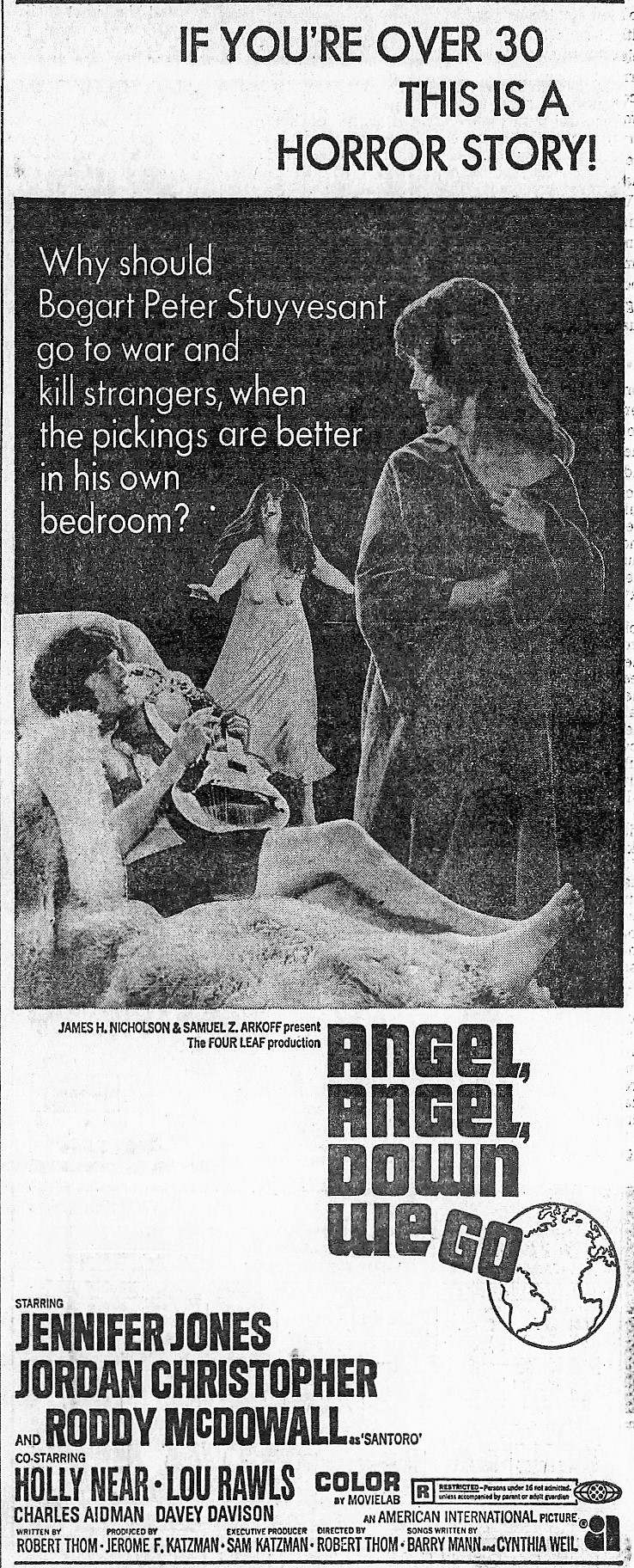
My guess is that this was Jennifer Jones' mantra throughout the entire filming of Angel, Angel Down We Go
What tends to fade from memory are the far more numerous instances in which actors, in a sincere attempt to break from type, inflict untold damage on years of hard-won legitimacy and respect by taking on thankless roles that end up making them look more ridiculous than courageous.
One such doozy of a miscalculation is the aptly titled Angel, Angel, Down We Go, a film that sees Oscar-winner and member of old-school Hollywood royalty Jennifer Jones extend herself so
far out on a wobbly limb that the only trajectory can be downward.
Angel, Angel, Down We
Go is a marvelously loopy artifact from the age of culture-clash psychedelia, and a primo example of that weird transitional period in motion picture history
(roughly 1966 through 1970) when it appeared at times as though Hollywood had completely
lost its mind. How else to explain the green-lighting of a film that casts classy Jennifer Jones as a former porn star unhappily married to a gay industrialist (Charles Aidman), saddles her with an unwanted, overweight teenage daughter (Holly Near), and has her seduced by a Jim Morrison-esque rock star (Jordan Christopher)?
Released by American International Pictures (the Drive-In exhibitor's best friend) and penned by the same writer who delivered the 1968 sleeper hit Wild in the Streets, Angel, Angel, Down We Go is an exercise in youth-rebellion exploitation that didn't pay off back in 1969 but reaps considerable dividends today for being an astonishingly weird product of a time when Hollywood was seriously grasping at creative straws.
Jennifer Jones as Astrid Steele
Jordan Christopher as Bogart Peter Stuyvesant
Holly Near as Tara Nicole Steele
Charles Aidman as William Gardiner Steele
Rock star/mogul/cult leader Bogart Peter Stuyvesant ("My mother went into labor pains during a
Bogart flick...she almost dropped me in the lobby!") first deflowers, then insinuates
himself into the life of the unloved, overweight debutante, Tara Nicole Steele. Stuyvesant and his motley band of sky-diving cultists (an uncomfortable-looking
Lou Rawls; obligatory pregnant flower child, Davey Davidson; and an underutilized
but probably just-happy-not-to-be-wearing-monkey-makeup, Roddy McDowall) see in Tara
a symbol of overindulged American excess. In her decadent parents, they see the personification
of older-generation corruption and greed.
Bogart Peter Stuyvesant & Co. have plans for this family, but beyond, perhaps, talking them to death, it's difficult to know just what the endgame is for the seriously unhinged young man. We know it has something to do with youth rebellion, but as to what form that rebellion is supposed to take, your guess is as good as mine. "You're insane!" people keep shouting at him, as though we hadn't noticed.
All I know is that along
the way, Bogart sings a passel of pop/rock songs written by the Oscar-nominated songwriting team
of Cynthia Weil and Barry Mann (Somewhere Out There), spouts a lot of anti-establishment gibberish, and in the end, winds up seducing mom, dad, and daughter. Not necessarily in that order.
"We say hip, hooray, hip. hip hooray for fat!" The newly liberated Tara dances to Bogart's ode to corpulence: "The Fat Song." Barely considered chubby by today's Big-Gulp, Super-Size standards, 19-year-old Holly Near, making her film debut, gained five pounds for the role (the studio asked for 20).
Angel, Angel, Down We Go is the screenwriting/directing debut of Yale graduate (so much for higher education) Robert Thom. Thom adapted the screenplay from an unproduced 1961 play he wrote for his wife Janice Rule. Yale's resume as a screenwriter is a mixed bag, representing the good: All the Fine Young Cannibals, the bad: The Legend of Lylah Clare, and the unseen (by me) Death Race 2000. In speaking of what he intended with this film, he explained he saw Angel Angel Down We Go as: "A far-out version of a 'The Green Hat' (Michael Arlens) kind of play about a wild
girl heading for destruction…a present-day type of F. Scott Fitzgerald heroine."
(Source: Jennifer Jones: The Life and
Films by Paul Green).
That it was adapted from a play certainly explains the film's
talkiness (you've never encountered a lippier group of flower children in your
life), but the rest of that quote is a bit of a stretch. Anyone detecting even a
note of F. Scott Fitzgerald in this monumentally disjointed morass has likely
gone the way of Zelda. Angel, Angel, Down We Go was Robert Thom's debut/swansong as a director.
Pills with an alcohol chaser accompany Jennifer Jones' explanation for why she named her daughter Tara. Meanwhile, David O. Selznick (Jones' recently deceased real-life hubby and Gone With the Wind producer) can be heard spinning in his grave.
WHAT I LOVE ABOUT
THIS FILM
The economic power of the newly emboldened youth audience of
the late '60s really threw old-guard Hollywood for a loop. Long out of touch and more concerned with capitalizing on the counterculture zeitgeist than trying to understand it, Hollywood during this period produced some of the oddest, most out-there films in the annals of cinema history. Angel, Angel, Down
We Go is an unholy marriage of studio-system aesthetics that tries to pass itself off as an underground college-campus youth-rebellion flick.
The result
is a work of pandering insincerity that manages to alienate two potential audiences in one swing. Young people, the movie's principal target audience, must have found it "challenging" to have a movie about the morally corrupt over-30 set try to pass off 40-year-old Roddy McDowall and 35-year-old, receding-hairlined
Lou Rawls as agents of an impending youth revolution. And the older movie-going public, those old enough to know and appreciate the name Jennifer Jones, must certainly have gone into apoplexy when confronted with so much profanity, drugs, sex, and bad rock music.
The Mild Bunch (L.to R.) Soul singer Lou Rawls makes his embarrassing film debut as Joe. Jordan Christopher fronted the rock group "The Wild Ones" and was married to Sybil Burton (Richard's ex) at the time. Holly Near is a well-known folk singer and activist. As pregnant "teen" Anna Livia, Davey Davidson is known to fans of the sitcom Hazel as Nancy, Mr. B's virginal niece. Roddy McDowall, as Santoro, was friends with director Robert Thom and must have owed him a favor.
For fans of bizarre cinema, however, all of the above
are merely ingredients that went into creating one of the most obscenely entertaining train wrecks from a major studio. The kind of film that could not have been made at any other time in cinema
history. Get a load of this dialogue:
Jennifer Jones shouting at her husband- "Oh, you're out of your Chinese skull!" (He's not Chinese.)
Jennifer Jones playing the truth game- "I made 30 stag films and never faked an orgasm!"
Jennifer Jones to her masseuse- "Stop it, Hopkins, you're hurting me. You're a bloody, sadistic dyke!"
Jennifer Jones in a moment of self-reflection- "In my heart of hearts, I'm a sexual clam."
Jennifer Jones rebuffing the advances of the man who just bedded her daughter- "There's a word for you, but I don't think I even know what it is."
Yes, Miss Jones has the lion's share of the film's quotably bad dialogue. However, she delivers it with so much gusto and bite, one wonders if perhaps she thought she was appearing in another absurdist hoot like John Huston's Beat the Devil (1954). Unfortunately for her, Robert Thom is no Truman Capote.
Only in the Sixties My favorite film of five-time Oscar nominee Jennifer Jones is Madame Bovary (1949). Who would guess that 20 years later, the 49-year-old actress would appear in a film requiring her to rest her head near the crotch of a 26-year-old, naked balladeer?
PERFORMANCES
Jennifer Jones in Angel, Angel, Down We Go is less an instance of against-type casting so much as it is "What the hell was she thinking?" casting. If you can get over the shock of seeing the star of The Song of Bernadette wallowing in the sordid gutter of sex and drug exploitation, you can catch glimpses of a sensitive performance that never had a chance. She's particularly good in a scene where her character revisits the Santa Monica Pier cotton candy stand she worked at as a girl. Alas, the quiet moments in this film aren't allowed to last too long.
The ever-refined Astrid Steele responds to her daughter complimenting her on being "The most beautiful woman in the world."
Watching an actress as good as Jennifer Jones in a film as crude and intentionally vulgar as this, you never get a chance to applaud her "bravery" in breaking out of her Selznick-Shell. Why? Because not only is the film so far beneath her, but you're never quite sure whether she's in on the joke. Her participation feels a little like it's part of a secret put-down, and you feel a little embarrassed for her. Angel, Angel, Down We Go joins the ranks of the many Hollywood films from this era that made it their business to present former leading ladies of the silver screen in as unflattering a light as possible: Lana Turner, The Big Cube (1969) / Eleanor Parker,Eye of the Cat (1969) / Rita Hayworth, The Naked Zoo (1970) / Miriam Hopkins, Savage Intruder (1970), and Mae West, Myra Breckinridge (1970).
"The Biggest Mother of Them All!" Astrid builds up a head of indignant steam listening to Bogart's newest insult composition, the sprightly ditty, "Mother Lover." In the meantime, Tara nervously waits for the shit to hit the fan.
THE STUFF OF FANTASY
One of the niftier byproducts of Hollywood's embracing of
the economic potential of the sexual revolution was the industry's fascination
with homosexuality, bisexuality, and narratives in which opportunistic young
men sleep their way through entire families (Entertaining Mr. Sloane - 1970, Something
for Everyone -1970, Teorema -1968). As I first saw Angel, Angel, Down We Go
when it came out in 1969, and I was just 12 years old, what made the biggest impression on me, and contributed to my seeing it at least three times that summer, was the surprising amount of male nudity. It's one of those rare exploitation films where the women stay dressed while the guys doff their clothes left and right. The movie made absolutely no sense to me then (nor now, for that matter), but with all that male skin on parade, who was I to complain?
How can you hate a film whose first four minutes feature a girl's voiceover narration praising her perfect parents, only to have the idealized father appear in the shower with a young man!
The ever-game Roddy McDowall shows that his celebrated boyish charm didn't stop at the neck. Co-star Lou Rawls threatened to walk off the production when asked to appear nude, telling the director to take it or leave it - "I worked ten years to get where I am, and I'm not going to destroy that image in 10 minutes."
After seducing the daughter and the mother, Bogart (Jordan Christopher, bottom tier) literally takes the place of Mr. Steele's previous boy-toy (top tier, actor unknown).
THE STUFF OF DREAMS
Filmed in February of 1968, Angel, Angel, Down We Go was released in August of 1969, the same month as the Manson murders. This was the film's title when I saw it at San Francisco's Embassy Theater in early 1970 on a double bill with Easy Rider (2 New Youth Hits! the marquee read). A year or so later, I'd heard it was redubbed Cult of the Damned and re-released in a tasteless effort to capitalize on the film's eerie similarities to the Manson case, whose trial was underway.
Jordan Christopher was just one of several actors (among them Christopher Jones and Michael Parks) who tried hard to work a James Dean vibe in late '60s exploitation films
A bomb under either title, Angel, Angel, Down We Go, has more or less disappeared into what some might call well-deserved obscurity. But for those with a taste for the bizarre, a taste for the jaw-droppingly weird, a taste for the clumsy collision of old Hollywood and the shape of things to come…well, Angel, Angel, Down We Go is a psychedelic mind trip well worth taking.
Much of Angel, Angel, Down We Go was shot at a Beverly Hills mansion that once belonged to Marion Davies.
Literally high on drugs, Tara finds she can't get down from the ceiling (I told you this movie was weird)
NAME DROPPER'S CORNER
In the mid-'90s, I worked as a personal fitness trainer for the late Jennifer Jones. She had developed a lingering back problem from hoisting a little girl up and down many flights of stairs in The Towering Inferno (1974 ) and she worked out 5 days a week to keep strong and stay in shape. I remember her as an extremely gracious lady with a wonderful sense of humor and terrific discipline when it came to exercise.
She lived in a high style not at all dissimilar to the character she played in this film (her home was a veritable museum of priceless art. She had a round-the-clock staff of security guards. And she had her hair done every day, her personal hairdresser usually arriving as I was departing). After working with her for some time, I found the courage to tell her that Angel, Angel, Down We Go was the first film of hers I'd ever seen. Laughing, she replied, "I'm sorry to hear that. I'm afraid I might owe you an apology." When I said it inspired me to see her other films, she told me, "I'm glad of that. But I hope you've forgotten about it... I certainly have."
As much as I wanted to bring the subject up again over the next few months (I wanted to know what everyone wants to know when they see this movie, "What possessed you?"), I nevertheless erred on the side of caution and kept my mouth shut on the topic. It felt like the polite and professional thing to do, but it certainly did nothing for satisfying my film-geek curiosity.


.JPG)


.JPG)


.JPG)
.JPG)


.JPG)