Showing posts sorted by relevance for query the sterile cuckoo. Sort by date Show all posts

Wednesday, February 27, 2013

THE STERILE CUCKOO 1969

Before I saw The Sterile Cuckoo in 1969, I had only the vaguest impression of Liza Minnelli. I had a dim memory of her as this somewhat hyperactive, inauthentic personality who popped up occasionally on her mother’s variety TV show, and another as an over-earnest Red Riding Hood in a 1965 musical TV special titled The Dangerous Christmas of Little Red Riding Hood. Having missed her film debut in the 1967 Albert Finney vehicle Charlie Bubbles, The Sterile Cuckoo marked my first encounter with Liza Minnelli, the actress, and, in the character of Pookie Adams, my first exposure to what eventually evolved into Liza Minnelli, the screen persona.
Liza Minnelli as Mary Ann "Pookie" Adams
Wendell Burton as Jerry Payne
The Sterile Cuckoo, the first film effort by late director Alan J. Pakula (Klute, Starting Over) is a fairly straightforward, bittersweet tale of first love presented as a touching, coming-of-age character study. Soft-spoken biology major Jerry Payne (Wendell Burton) encounters bespectacled oddball Pookie Adams (Liza Minnelli) as both are waiting for a bus to take them to their first semesters at neighboring colleges. The extroverted but socially awkward Pookie, who either misinterprets Jerry's passive malleability as interest or willfully disregards what is more apt to be amused indifference, insists that the two have instantly bonded and share a mutual attraction ("We got along terrifically on the bus!" she asserts).

Pookie, an outcast who aggressively overcompensates and guards her lonely vulnerability behind the labeling of others as “creeps,” “weirdos,” or “bad eggs,” is clearly drawn to the nice, button-down sweetness of the biology major, but one senses that she's a type that habitually latches onto strangers. For his part, the overwhelmed Jerry doesn't so much warm to Pookie’s charms as succumbs to the force of her persistent will.
Pookie worms her way into yet another heart
Yet in that strange way in which a relationship is often forged from an individual of somewhat amorphous character being drawn/surrendering to the superficially dominant character of another; the very dissimilar Pookie and Jerry embark upon a swift but tenuous romance. Taking place over the course of one school year, The Sterile Cuckoo follows the couple’s evolution and eventual dissolution as Jerry begins to grow into himself just as Pookie’s love-starved neediness starts to reveal itself to be part of larger, more deeply rooted emotional problems.
Tim McIntire plays Jerry's roommate Charles Schumacher (or Shoonover...the film can't seem to make up its mind), a typically macho, hard-drinkin' fratboy given to an excess of sexual braggadocio. On the surface. The reality of this ostensibly "popular" character's life underscore The Sterile Cuckoo's theme that all teens struggle to find their identities. Pookie's self-absorbed wallowing in her own problems blinds her to an awareness of  the feelings of others. 

As a 12-year-old kid enamored of too-mature films I scarcely understood, The Sterile Cuckoo was one of the few movies I saw during this period that didn't feel like a two-hour excursion into the uncharted territory of mysterious adulthood. Although the characters are supposed to be 18 or 19, the issues plaguing Pookie and Jerry (friendships, identity, loneliness, peer group acceptance) were, for the most part, things to which I could both relate and recognize within myself. I identified with Jerry’s timidity and deliberate, watchful approach to others. Likewise, as a gay youth, I empathized both with Pookie’s perception of herself as an outsider and her reject-them-before-they-reject-you, knee-jerk defense mechanisms.
The painful paradox of finding yourself snubbed by the very group you profess to have no interest in being a part of is brought to almost excruciating life by Minnelli in this scene at a campus hangout. Hoping to have found someone with whom she can share her outcast isolation, Pookie is unnerved to discover that Jerry, by all appearances a quiet loner, is actually rather socially poised and liked by others.

But what I think I responded to most was the film’s insight into the dynamics of a relationship between two loner personalities drawn together in their isolation. Both Pookie and Jerry are insecure, but each responds to their circumstances differently. Pookie’s insecurity causes her to alienate all others except the one person she selects to smother with all the love she has, all the while emotionally draining them with demands for all the love she needs. Jerry lacks confidence as well, but as his insecurity is neither fear-based nor self-defensive, he's capable of recognizing that most everyone is a little afraid to reach out to others, and that what matters is that one make a little effort.
Unlike the offensive message behind the beloved 1978 musical Grease, whose moral is to encourage teenage girls to change everything about themselves in order to gain peer acceptance, The Sterile Cuckoo is not a film about the need to conform... it's about the inevitability of growing up.
"Pookie, maybe they aren't all so bad. Maybe everybody's just a little cautious of everybody."

WHAT I LOVE ABOUT THIS FILM
Always a sucker for movies about vulnerable characters (and movies that make me cry), I fell in love with The Sterile Cuckoo and saw it about six times back in 1969. It sold me on Liza Minnelli as a genuinely talented actress, and inspired me to read the surprisingly different-in-tone John Nichols novel. For the longest time I harbored a memory of The Sterile Cuckoo as just a sad/funny look at first love, and perhaps that’s all it's intended to be. But seeing the film today, in light of all we've come to learn about mental illness (coupled with our culture’s obsession with medicating all idiosyncrasies out of the human personality); I’m struck by how seriously disturbed Pookie seems to me now. That certainly wasn't the case when I was young. She starts out as some kind of early exemplar of the Manic Pixie Girl cliché, but what with her self-delusions, pathological lying, death-obsession, mood swings, and crippling persecution complex, it’s hard to shake the feeling that Pookie is considerably more than just a wounded misfit in search of someone to love her.
Death-fixated Pookie likes to hang out in cemeteries
PERFORMANCES
Liza Minnelli deservedly won an Oscar nomination for her intense and deeply committed performance in The Sterile Cuckoo. Cynics and the industry savvy might take issue and label such an ostentatiously underdog role as Pookie Adams--significantly altered and made more sympathetic (pathetic?) than in the novel--to be just the sort of calculated Oscar-bait to attract Academy attention. But given that a similar gambit didn't work for Shirley MacLaine that same year for what many consider to be an equally manipulative and maudlin turn in Sweet Charity; I think it’s fair to say that Minnelli put this one over in spite of Pakula’s and screenwriter Alvin Sargent’s (Paper Moon, Ordinary People) determination to stack the emotional deck so heavily in her favor.
The character of Pookie Adams was conceived for the screen as one far more tragic than depicted in the novel.  

It’s popular to dismiss the less-showy work of newcomer Wendell Burton in the reactive, relatively thankless role of Jerry Payne, but I think his low-key naturalism and likability provide the perfect contrast to the nervous hyperactivity of Minnelli’s character (it’s impossible to watch her Pookie Adams and not think of Anne Hathaway's legendary eagerness to please). His character’s subtle growth is very well played, and to Burton’s credit, he’s never wiped off the screen by Minnelli (no easy feat, that). At the time of The Sterile Cuckoo's release, Burton appeared poised for stardom. But after next appearing in an almost identical role as a soft-spoken prison inmate in Fortune & Men’s Eyes (1971) he worked primarily in TV before retiring from acting in the late 1980s.

THE STUFF OF FANTASY
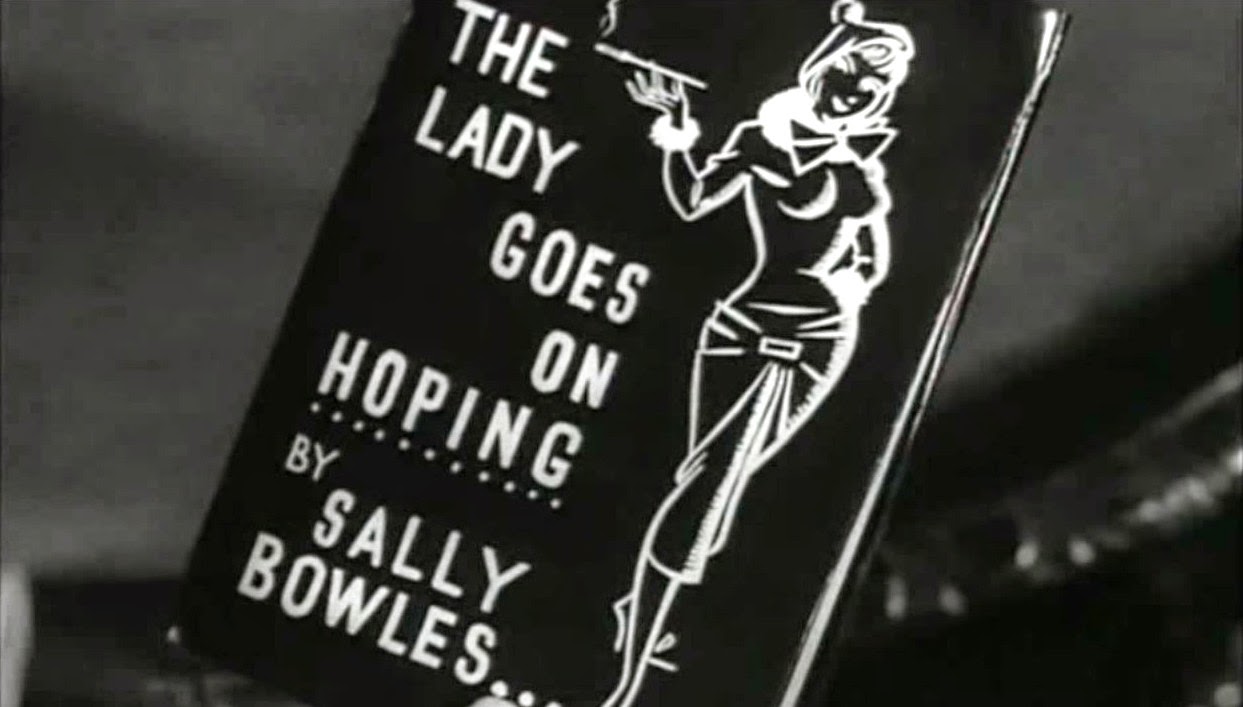
Earlier I mentioned how The Sterile Cuckoo marked my introduction to Liza Minnelli, the screen persona. By this I mean that for all intents and purposes, one can find the genesis of the entirety of Liza Minnelli's adapted screen persona in The Sterile Cuckoo’s Pookie Adams. Nowhere is this more obvious than in its similarities to her Oscar-winning role in Bob Fosse's Cabaret (1971). Fans of that film are apt to recognize in Pookie Adams a nascent version of Sally Bowles.
Pookie & Sally: A Comparison
1. Both sport waifish, gamine bobs.
2. Both mask their inherent insecurity behind displays of delusional self-confidence. 
3. Both win over reluctant, passive men through the sheer force of their personalities.
4. Both suffer from neglectful fathers.
5. Each has a big emotional breakdown scene that virtually screams, “Give that girl an Oscar!”
6. Both have pregnancy scares.
7. Both have gaydar issues. Pookie thinks (perhaps correctly) that Jerry’s roommate is gay, while Sally fails to detect that her boyfriend and her lover are bisexual.
8. Both wind up scaring off their lovers.
Come-on: Would you like to peel a tomato?
Come-on: "Doesn't my body drive you wild with desire?"
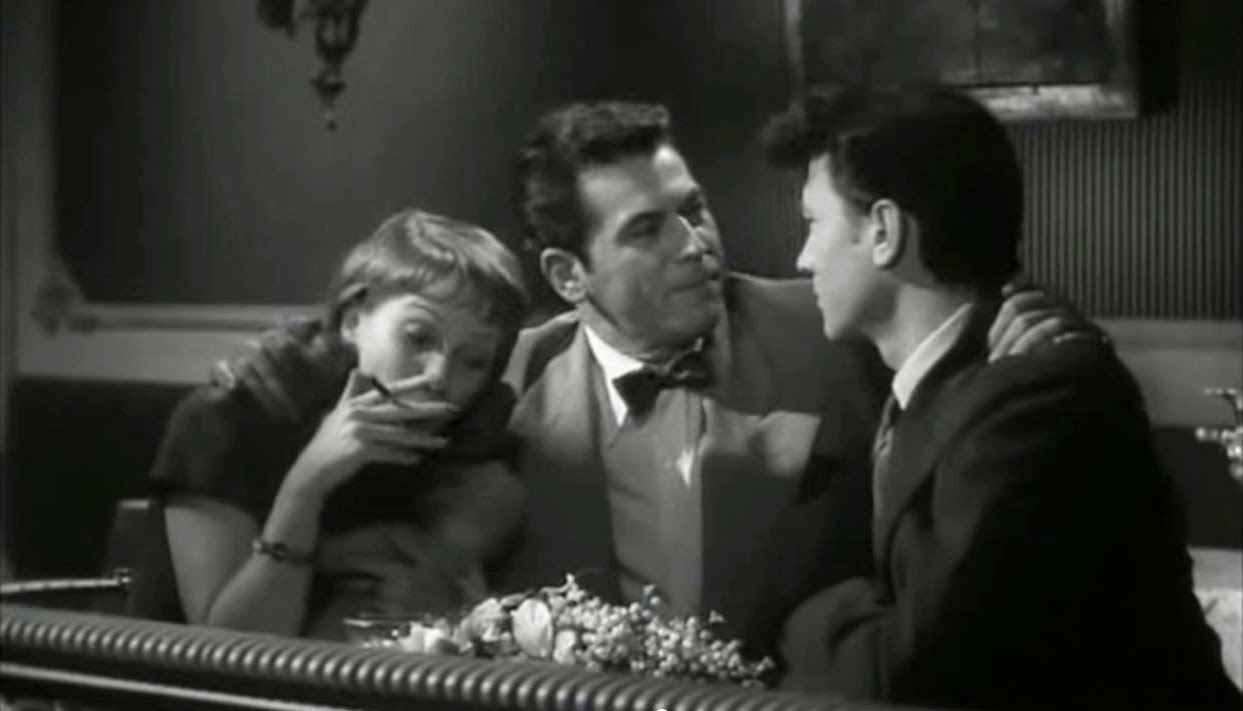
The Sterile Cuckoo (top) and Cabaret (bottom) share scenes of Liza Minnelli as the sexual aggressor. Here she attempts to seduce lookalike males with her supine figure.


THE STUFF OF DREAMS
The Sterile Cuckoo is one of those forgotten movies in need of rediscovery. It’s more character-based than story-driven, so it's not heavy on plot; Pookie’s character can prove more annoying than poignant to some; and if you take a dislike to the film’s Oscar-nominated theme song “Come Saturday Morning,” you’re likely to be sent screaming into the streets, for it comprises the totality of the film’s soundtrack. But to me, it’s a perfectly wonderful film of humor, sensitivity, and considerable emotional insight. Beautifully shot and an authentic-feeling record of the late '60s, The Sterile Cuckoo has standout performances throughout (Minnelli is at times phenomenal in this), and I think the conveyance of the brief romance is beautifully handled...both its beginning and its painful end. Definitely worth a look.
Oh, and as to the significance of the title? Nowhere to be found in the film (allegedly cut), but referenced in the novel as a poem Pookie writes about herself.
At the start of the film, we don't understand the silence between the two characters sitting on a bench waiting for the arrival of a bus. When this image is echoed at the end, we have a better understanding of the pattern of Pookie's life and a sense that this has been-- and will continue to be--a scenario she'll play out again and again.

Mark, at Random Ramblings, Thoughts & Fiction and a few Internet friends have all shared with me tales of having had encounters with a real-life Pookie Adams, so I figured I should share my own.
My particular Pookie was a bit of an outcast, wore glasses, and was ragingly funny. She was keenly perceptive and cutting when it came to the shortcomings of others, yet oblivious to her own. She was a deeply loyal friend, but somewhat suffocating in that if you were her friend, you had to be only HER friend. There was no room for anybody else. She was happiest in having the two of us share all of our time together sitting apart from others and putting them down. In my own insecurity, this felt for a time like a kind of strength to me, too, but it wasn't long before I recognized what a self-defeating, one-way street this attitude was. 
We were an insulated, impregnable world of two, but it was a world of cowards. As much as I enjoyed her company, the ultimately toxic nature of her mean-spirited humor (it was so obvious that she was in pain and so afraid of others) drove us apart.  I see in The Sterile Cuckoo and Liza Minnelli's excellent performance an exacting depiction of a certain kind of wounded personality. One I'm learning is not as unique as I'd once thought.

Scene from "The Sterile Cuckoo"    1969


Copyright © Ken Anderson   2009 -2013

Friday, June 27, 2014

I AM A CAMERA 1955

"I am a camera with its shutter open, quite passive, recording, not thinking."
Christopher Isherwood  - The Berlin Stories 1945

I've wanted to see I Am a Camera for 42 years. That's the length of time I've been aware ofyet unable to lay eyes uponthis little-known, rarely-televised, not-available-on DVD, all-but-forgotten adaptation of the successful Broadway play that inspired the Broadway & film musical Cabaret and gave the screen its very first Sally Bowles.
Julie Harris as Sally Bowles
Laurence Harvey as Christopher Isherwood
Shelley Winters as Natalia Landauer
Anton Diffring as Fritz Wendel
Forty-two years ago: It was 1972, I was a freshman in high school, and Cabaret had just opened nationally. I was eager to see the film on the strength of my fascination with Bob Fosse's choreography in Sweet Charity (1969) and my infatuation with Liza Minnelli in The Sterile Cuckoo (1969), but in order to persuade my family to select it for a night out at the movies, I had to rely on the scores of critical raves quoted in the newspaper ads. Which was all for the good because I knew next to nothing about just what Cabaret was.

I had absolutely no foreknowledge of Christopher Isherwood's 1945 novelized twin-memoir: The Berlin Stories; I was in the dark about playwright John Van Druten (I Remember Mama) adapting one of those short novelsGoodbye to Berlin—into the 1951 play I Am a Camera (prompting theater critic Walter Kerr's terse, too-oft-quoted review, "Me no Leica"); and I was thoroughly unaware that said seriocomic play had served as the structural source for the 1966 musical Cabaret…the original Broadway production serving as merely the launchpad for Fosse's significantly reworked movie adaptation.

Well, as if to prove the adage "ignorance is bliss," a byproduct of my state of unenlightenment was that it afforded me the rare opportunity of enjoying Cabaret free of the usual burdens that come with seeing a beloved stage and/or literary work adapted into another medium. That feeling of never fully being "in the moment" born of anticipating the omission or mishandling of some favored line or bit of business. Sometimes it's a ceaseless, almost involuntary process of comparison and sizing up which goes on in your head as you watch, hoping expectation doesn't outpace execution.
Lea Seidl as Fraulein Schneider, the landlady
Ron Randell as Clive Mortimer, the rich American playboy

Like most everyone who saw it at the time, I was utterly blown away by Cabaret. Especially its stylish, darkly atmospheric depiction of the social and moral decay of pre-Nazi Germany in the '30s…so ideally suited to Bob Fosse's particular brand of razzle-dazzle cynicism. In an attempt to rectify my prior obliviousness, I subsequently took to reading everything I could about the film.

My first discovery was that it was the rare Cabaret review or feature article which didn't reference the film version of I am A Camera. Always unfavorably. Some remarked on the film's failure to do justice to Van Druten's play, others complained that it didn't successfully bring to life Isherwood's colorful characters, all cited it as the first on-screen incarnation of Sally Bowles. While it definitely came as a surprise to me to learn that Fräulein Bowles (who to this day is difficult to envision as anyone other than Liza Minnelli) appeared on film a whopping 17 years before Cabaret even existed, what really knocked me for a loop was that it was in the startlingly against-type personage of Julie Harris.

I couldn't imagine two actresses with less in common than Liza Minnelli and Julie Harris. Even in the most democratic of fantasies, I'm hard-pressed to envision any point at which the talents of these two very gifted ladies might intersect to make feasible the notion of their being cast in the same role. One's a jackhammer, the other a tap on the shoulder. It piqued my interest no end to discover that it was Harris (an actress I adored, but always associated with reserved, Plain Jane roles like in The Haunting, East of Eden, and You're a Big Boy Now) who originated the role of one of literature's most flamboyant extroverts...and won a Tony Award for it in the bargain!
Divine Decadence
Sally bares her emerald-green nails (and tigress snarl)
Suddenly, I am A Camera became a movie I absolutely had to see. In 1972, I hoped the popularity of Cabaret would occasion a resurfacing of it on late-night TV or at a local revival theater…but no such luck. My frustration knew no bounds. In those pre-cable/pre-DVD days, it certainly wasn't out of the ordinary to have to wait a long time for a favored old movie to make the rounds, but I am A Camera was a unique case in that absolutely no one I knew (not my parents nor my older sister, who was a Late Show maven if ever there was one) had ever heard of it, much less seen it.
Years passed (decades, actually), and I am A Camera eventually became one of those films (like Andy Warhol's L'Amour) I resigned myself to never seeing. Then, two weeks ago, just as I'd all but forgotten all about it, what do you know?... there it was, big as life on YouTube!!!!

So it's true, good things come to those who wait...for a VERY long time!


WHAT I LOVE ABOUT THIS FILM
Having read so little that was encouraging about I Am a Camera, I'm afraid that when the time came for me to finally see it, I did so more out of curiosity than conviction. After it was over, I wanted to give each of those early critics a solid trouncing over the head (myself included, for believing them), for to my great surprise, I found I Am a Camera to be a thorough and utter delight. Maybe I wouldn't have thought so back in 1972 when the air of solemnity Fosse brought to Cabaret rode the then-popular wave of pessimism of so many Nixon-era films (which flattered my adolescent self-seriousness); but today, I Am a Camera's unremittingly old-fashioned, studio-bound, almost farcical, light-comic approach distinguishes it so significantly from every other adaptation of Isherwood's memoirs I've seen, that it stands far and apart from comparison and represents to me, a work unique unto itself.

Presented in the form of an extended flashback told to fellow writing associates by "confirmed bachelor," now successful author Christopher Isherwood (Harvey), I Am a Camera recalls the years Isherwood spent as a struggling writer in Berlin in the 1930s. In vignette style, the film recounts his platonic, life-changing friendship with free-spirit Sally Bowles (Harris), a modestly talented cabaret singer and self-styled bohemian whose flighty manner and impulsive behavior propel him into adventures that ultimately serve as the basis and inspiration for his early writing successes. A subplot involving his only-slightly-worldlier friend, Fritz (Diffring), a would-be gigolo and closet Jew, wooing a department-store heiress (Winters), introduces a bit of drama and brings Germany's mounting Nazi threat to the forefront.
The Nazi Intrusion
Sally, Clive, and Christopher momentarily have their spirits dampened by a Jewish funeral procession  

I Am a Camera doesn't deviate significantly from the basic plot of Cabaret, its chief point of departure being merely one of approach. While Minnelli's Sally Bowles symbolized the kind of I'm-dancing-as-fast-as-I can, willful self-deception that allowed the Nazis to take over a Depression-era Germany by salving its sorrows with decadence. I Am a Camera presents Isherwood's adventures as a lighthearted coming-of-age story and depicts Bowles as something of an early incarnation of that genre staple: the Manic Pixie Dream Girl (thank you, Nathan Rabin) – the quirky, childlike female character who brings chaos into the orderly life of a sensitive, button-down type, only to leave him a better, more-matured artist for it.

Katherine Hepburn played one in Bringing Up Baby (1938), and so did Sandy Dennis in Sweet November (1968). Certainly, Minnelli's Pookie Adams from The Sterile Cuckoo qualifies (although the word "nightmare" might be more appropriate than dream), and the characters of Dolly Levi and Mame Dennis from Hello, Dolly! and Auntie Mame, respectively, are nothing if not the Manic Pixie Dream Matron. Of course, the great Grande Diva of Manic Pixie Dream Girls is Audrey Hepburn's Holly Golightly in Breakfast at Tiffany's, and ultimately it is this film, not Cabaret, which I Am a Camera most recalls.
One of the setpieces of I Am a Camera is a raucous, remarkably staged party scene that predates Blake Edwards' iconic cocktail party sequence in Breakfast at Tiffany's 

Truman Capote's Breakfast at Tiffany's (published in 1958) and Christopher Isherwood's Goodbye to Berlin (published in 1939) are novelized memoirs by gay men recalling their transformative friendships with quirky, unconventional women of liberated sexuality. Whereas Tiffany's was converted into a romantic comedy (even Cabaret imposed a false romance), Camera leaves Isherwood's homosexuality as coded as the '50s would allow (his declaration, "I suppose I'm not the marrying kind," is tantamount to coming out). 

PERFORMANCES
Whether or not one cares for I Am a Camera's lighthearted touch and bittersweet Hollywood happy ending (which still feels more honest than making the Isherwood character bisexual [the movie musical] or straight [the stage musical]), I can't imagine any fan of classic cinema not being enchanted by the sight of so many brilliant dramatic actors displaying such a talent for comedy.
British actor Laurence Harvey, long a favorite of mine yet so unaccountably stiff and affectless in so many of his American roles, is appealingly naïf and boyish as Isherwood. I've always harbored a big crush on him, so perhaps I'm not exactly what you'd call an objective judge, but I'd easily rank his work in I Am a Camera alongside Room at the Top and Expresso Bongo as among Harvey's best film performances.
In a reversal of her role in 1951's A Place in the Sun, Shelley Winters
 plays an heiress wooed by a fortune-hunter 

As for the strikingly handsome Anton Diffring, so chilling as the villain in Fahrenheit 451 and an actor who literally made a career out of playing cold-hearted Nazis, I never would have guessed he'd be so charming a light comedy player. Honestly, I think this is the first film I've ever seen him smile! Several years away from the grating, undisciplined performances that would later brand her a camp film favorite, Shelley Winters has a surprisingly small role and displays a worrisome German accent, but she is endearing beyond belief. It's easy to forget what an accomplished comedienne she could be.

But hands-down, Julie Harris walks off with my highest praise. She's nothing short of sensational. I've seen Harris in many things over the years (even on Hollywood Squares, of all places), but I've never EVER seen her this perky and playful. I had no idea she could be such a flirtatious, funny, physical, and a vivacious personality. Her versatility is on full display here, capturing the many shades of Sally's mercurial personality, from her childlike vulnerability to her flashes of self-interested callousness. Speaking in that rapid-fire manner I associate with George Cukor movies, her Sally Bowles is less a bohemian iconoclast and reminds me more of Kathryn Hepburn's Eva Lovelace in Morning Glory (1933): all self-centered chatter and ostentatious show, but ultimately touching.
I found not a single moment of Harris' performance wanting, save for the poorly-matched dubbed singing voice she's given during her big cabaret number--the languid vocalist fails to capture the sprightliness of Harris' physical interpretation (I'm reminded of the too-calm dubbed voice attributed to Rita Moreno in West Side Story). Harris doesn't appear to be lip-syncing, leaving me to suspect the other voice was added post-production. i remember hearing Harris sing on the cast album of the 1965 Broadway musical Skyscraper ... she mostly went the Rex Harrison talk-sing route.

In the end, what pleased and surprised me most about Harris as Sally Bowles is the manner in which she tackles the role with such ease and command, inhabiting her character so winningly and completely that she resists comparisons to Liza Minnelli, making the part her own. No easy task, that.
"I remembered your eyes. It was as if they were asking me to look at you and yet not see you!"

It's believed that Julie Harris' outstanding performance was overlooked for an Oscar nomination because I Am a Camera--a British production that failed to punish its sexually promiscuous heroine or delete mention of abortion--was denied a Production Code Seal, resulting in many theaters refusing to screen it, and some newspapers refusing to carry ads. In the UK, it was given the "Certificate X" rating.

THE STUFF OF FANTASY
While devoid of anything like Cabaret's "bumsen" scene, I Am a Camera is remarkably frank on the topics of sex, abortion, prostitution, and, depending on one's susceptibility to gay coding in old films, homosexuality. Considered risqué for its time, I was amused by just how much they were able to allude to in this 1955 film (a gay couple is briefly glimpsed in the nightclub scene) and enjoyed noting how many little details of style and content would later show up in Fosse's Cabaret.
This Sally sings at The Lady Windermere, but its clientele is pure Kit Kat Klub, 
as are its wall caricatures
Partaking of Sally's favorite pick-me-up: Prairie Oysters 
The Threesome...
...The Twosome
Laurence Harvey + rectal thermometer = sexiest scene in the film 
"I mean, I may not be absolutely exactly what some people call a virgin... ."

THE STUFF OF DREAMS 
For all the charismatic dominance of Sally Bowles and Julie Harris' standout performance, I Am a Camera ultimately manages to make good on its first-person title by being a story of one man's coming of age. The increased presence of the Nazis in Berlin challenges Isherwood's determination to just be a spectator in life, his ultimate inability to ignore its evil facilitates his growth as both a man and an artist.

For me, the poignancy of I Am a Camera is found in its final moments when it becomes clear (to us, if not the characters involved) that, like Dorothy in The Wizard of Oz, Christopher has possessed all along what he'd sought to find. As the only person to take pity on the abandoned Sally that first night in the club; to be the one individual who offered her shelter without the want of anything in return; to have remained by her side during a crisis, even going so far as to propose marriage and lose a promising job opportunity--Christopher was an "involved" participant in life from the very start. He was never for a moment the apathetic, unthinking "camera" he imagined himself to be.
Christopher ceases being the passive observer

Author Armistead Maupin in his 2008 introduction to Christopher Isherwood's The Berlin Stories (and if you haven't read The Berlin Stories, I highly recommend it), makes the observation that Isherwood's narrative device of assuming the role of the "camera" in his memoirs--the impartial, uninvolved recorder of events--was the author's way of protecting himself. A method of intentionally keeping his homosexuality out of his autobiographical stories for fear that its mere inclusion would distract from everything else in the text. 
A necessity at the time, but one rectified by Isherwood himself in his 1976 memoir Christopher and His Kind, in which the very same pre-war Berlin years documented in this film are recounted with a proud acceptance of his sexuality and an acknowledgment of its profound influence on his life and his art. 

I Am a Camera; a film shrouded in period-mandated gay coding (the aforementioned "confirmed bachelor" line) and starring a closeted gay actor portraying an asexual/sexually ambiguous character; is a product of its time, yet nevertheless contains a timeless message. Especially for the LGBTQ community, which has been so much a part of Christopher Isherwood's enduring legacy. Society, when not actively seeking to eradicate, has always encouraged gay people to "hide in plain sight." To, in effect, protect ourselves through anonymity and the acceptance of a non-participatory role as a "camera" on the periphery of life.
I Am a Camera - (inadvertently perhaps, but I'd like to think by way of the innate humanity of Isherwood and his characters)--exposes inauthenticity as an obstruction to growth (Sally, a woman defined by artifice, never changes). It promotes the necessity of being true to oneself (Fritz finds love and is compelled to reveal his true self to Natalia), and it affirms the absolute necessity that we must all be active participants in life...no matter how complicated things become.
Since I consider Bob Fosse's Cabaret to be such a perfect film and wasn't really hoping to find a movie to compare it to or replace it with, I rejoiced in I Am a Camera turning out to be so comprehensively and refreshingly different. Making up for those 42 years of longing, I've already seen it three times and marvel at what a splendid lost gem it is. To quote Sally Bowles, I think I Am a Camera is "Most strange and extraordinary!"


BONUS MATERIAL
The tune Sally Bowles sings in her cabaret act is the 1951 German song, "Ich Hab Noch Einen Koffer in Berlin" (I Still Have a Suitcase in Berlin), written by Ralph Maria Siegel. In this film, the song is given new English lyrics by Paul Dehn, the title changing to: "I Saw Him in a Café in Berlin."
You can Hear Marlene Dietrich sing the original song HERE.


Copyright © Ken Anderson  2009 - 2014

Thursday, March 30, 2017

MAKING A MEMORY: CINEMA & THE CULT OF LONGING

In this photo by Pulitzer Prize-winning San Francisco Chronicle photographer Joe Rosenthal (of Raising the Flag on Iwo Jima fame), the marquee for The Castro Theater advertises the double-feature It's a Mad Mad Mad Mad World and Far From The Madding CrowdI saw this very double feature at the Castro in January of 1971.

In Walt Disney's The Parent Trap (the good one with Hayley Mills), there's a scene where the twin raised in California greets her Boston grandfather (actor Charles Ruggles) for the first time. As they embrace, Susan (Mills), prolonging the hug, buries her face in the lapels of the old man's jacket.
Grandfather: "What are you doing?"
Susan: "Making a memory."
Grandfather: "Making a memory?"
Susan: "All my life...years from now, when I'm quite grown up, I'll remember my grandfather and how he always smelled of (sniffs his lapel again) tobacco and peppermint."

Apart from always giving me a major case of waterworks, this scene fairly sums up for me what moviegoing was like before the days of cable, satellite, VHS, Laserdisc, DVD, Blu-ray, and online streaming. When there was no telling when you'd ever have the opportunity to see a favorite film again, a standard part of the moviegoing experience was learning how to make a memory. Developing skills, rituals, and habits by which one could hold onto the experience of a movie for as long as possible.
A few of the double features I enjoyed at the Castro Theater circa 1968- 1969

For the devoted film fan, it was practically a survival tactic. By the time I reached my teens, it had become second nature for me to take detailed mental pictures; subconsciously log, file, and catalog significant sequences for later recollection rewind; and keep seismic record of the goosebump moments of every movie I liked. Even on those occasions when I'd sit through a movie twice in one afternoon, the subconscious goal was always the same: to have the film make as indelible an impression as possible on my psyche so that thereafter, the film became "mine." A memory of an experience I could relive and draw upon at will, be it to inspire, lift my spirits, or see me through any number of then-earth-shattering adolescent crises.
I fell in love with movies in the late '60s, back when there were only three TV networks, and feature films could take as long as two years to reach the TV screen. Then, lacking the technology allowing one to watch and rewatch a beloved movie in the comfort of one's home—ad nauseam, ad infinitum, to the point of torpor—one had to rely exclusively on extended memory. Deprived of having the easily-referenced details of a film at our fingertips (not to mention the demythologizing, demystifying, explain-every-subtlety-and-detail contribution of DVD commentary tracks), the memory of movies was all you had. And even then, often only in the form of fractured recall, personal reminiscence, and hazy, emotion-diffused impressions of the sort that made it easy to misquote and misremember entire scenes.
Ultimately, all of this goes to explain the origins of my subjective/emotional philosophy of cinema: In lieu of being able to possess a film materially, I came to base my love of movies on how they made me feel. And it was through this process of emotional connection that a particular movie became mine forever. 
The most coveted (by me) part of the Sunday San Francisco Chronicle was the entertainment "Date Book" section, known to locals as the "pink pages." Here would be found a host of movie-related articles and information about upcoming releases and premieres. This issue, dated June 16, 1968, mentions the forthcoming release of Rosemary's Baby (my #1 favorite film of all time) at the Century 21 Theater on Wednesday, June 26th.

But even strong memories require the occasional bolstering, so a big part of my film fandom as a youth involved finding new ways to prolong the moviegoing experience.

For example, my predilection for repeatedly watching the same movie is rooted in the fact that when I was growing up, once a film had completed its initial theatrical run, there was no telling when it would appear again. Back then, revival theaters (those that didn't specialize in underground, foreign, and art films) served the same purpose as TCM today, providing access to classic uncut films like Dinner at Eight & My Little Chickadee from Hollywood's Golden Age. When it came to mainstream releases like Who's Afraid of Virginia Woolf? or Up The Down Staircase, after their initial release (which was longer then and not so saturated), you had to scan the newspaper movie section waiting for them to reappear on the bottom half of a double or triple bill at some 2nd or 3rd-run neighborhood movie house. Short of that, there was waiting for them to appear on network TV—butchered, censored, and commercial-interrupted.
The Stepford Wives (1975) is one of my favorite films. It premiered on network television on Sunday, October 24, 1976. I was excited to see it again, but I remember being disappointed (though not entirely surprised) that the ending had been cut, dulling its overall impact. Enduring the subtle censorship or complete removal of favorite moments in cherished films was a standard aspect of the old-school "luxury" of having feature films broadcast into your living room.     

Since I liked to read, there was always the option of going to the local library and checking out the novels from which some of my favorite films were adapted (I especially liked the movie tie-in paperbacks, which always included loads of stills). A rare and mostly last-ditch effort on my part to keep a movie memory alive was the paperback "novelization"—a marketing device reserved for films adapted from original screenplays. I recall my experience reading the novelization of Thoroughly Modern Millie, mainly in terms of the great pains I took not to let the other boys at school see what I was reading. 
Fake Novel / Real Novel
Because I was shy, I always had my nose buried in a book at school. While reading Millie, I dreaded the day (which, mercifully, never came) when one of my classmates would ask me what I was reading, and I'd be forced to witness the color drain from their faces as I summarized its cotton-candy plot. On the other hand, The Sterile Cuckoo got me some unearned points from my English teacher, who misheard it as One Flew Over The Cuckoo's Nest. Thereafter, she seldom missed an opportunity to commend me on my reading
"At a high-school level!" (I was eleven) and selecting such heavy material for recreational reading. 

One of the more accessible in-home ways to sustain the excitement of movies (thanks to an older sister who spent substantial hunks of her weekly allowance on issues of Rona Barrett's Hollywood, Movie Mirror, Photoplay, and Silver Screen) was the movie fan magazine. While other kids my age were reading Batman comic books, I was reading about why Liz was too sick to satisfy her man and what new heartbreak The Lennon Sisters were having to endure. Before People magazine and 'round-the-clock "entertainment news channels" brainwashed folks into mistaking non-stop celebrity gossip for actual news, these magazines served their fandom purpose by keeping pop cultural ephemera where it belonged: on the sidelines amongst the scandal sheets and teen-celebrity magazines.
Screen Stories was my favorite movie magazine because each issue contained
complete, spoiler-filled synopses of all the latest flicks. With pictures!

I eventually gave up raiding my sister's stash of movie gossip rags once I discovered the "serious" movie periodicals section of the library. There, magazines with chi-chi names like Sight and Sound, Film Comment, Film Quarterly, and Films in Review not only fed my adolescent pretensions but also fostered my lifelong love of movie criticism and film analysis. Feeding my equally keen adolescent fondness for looking at pictures of naked men was British-based Films and Filming magazine, a self-billed "sensible magazine for serious film-goers" that was loaded with thoughtful and intelligent film reviews and could always be relied upon to feature the most salacious and homoerotic stills culled from even the most harmless movies.
When it came to helping me convince my parents that all the nudity in those age-inappropriate movies I so wanted to see was actually "artistic" and "significant to the plot," serious film periodicals (doesn't that sound better than movie magazines?) like Films and Filming proved invaluable.

Reading about movies or rewatching them to the point of memorization is all well and good, but those are but mementos of the mind. I don't know of a movie fan worthy of the name who, at some time or another, hasn't longed for some sort of concrete, tangible, take-home token of a film. 
For me, it was through the collecting of movie-themed souvenirs. Not so much when I was very young (because I had to wait for movies to come to the neighborhood theater), but in my teens, through to early adulthood, I loved it when first-run movies would offer some kind of chintzy promotional giveaway to the first 50 to 100 patrons at selected screenings. The thrill of being one of the few to take home a small memento of a movie (not to mention the silent, mean-spirited joy to be had in gloating over empty-handed patrons 101-plus) is what prompted my then-annoying penchant for dragging my friends to theaters way too early and making them stand in long lines (something which I quite enjoyed).
Andy Warhol's BAD opened in San Francisco on Wednesday, April 27, 1977. I didn't see the film until several years later, but at the time, the Music Hall theater sold the BAD T-shirt at the boxoffice. I purchased one for $5 and wore it so often that it disintegrated. The shirt pictured is a knock-off I bought on eBay in the '90s for considerably more than $5.

Over the years, I've sold or donated the bulk of my movie souvenir collection of buttons, T-shirts, banners, and posters, but stashed away somewhere in my apartment, I still have a few items of interest to nobody but me: the pinback button from the opening day of Alien (sounds good, but it's a dull graphic that merely has the words "You Are My Lucky Star" [the song Ripley sings to herself moments before the final attack] printed over a starry background); the sample soundtrack LP handed out at the premiere (and Joan Tewkesbury autograph signing) of the forgotten 1979 Talia Shire film Old Boyfriends; and a poster given out at an early screening of Peter Bogdanovich's Nickelodeon.
Although my original "Pray for Rosemary's Baby" button is the pride of my collection,
I still possess quite a few promotional pinback giveaways 

Another favorite of mine was the souvenir program. Big-budget movies and roadshow attractions traditionally sold "official" souvenir programs at the theater lobby concession stands...right next to the Jujubes and Milk Duds. Crammed with photos and PR puffery, these glossy brochures were little more than glorified pressbooks. But there was no better feeling than coming home from a movie, excited and tired but not wanting the evening to end, settling into bed and reading yourself to sleep while poring over all that prepackaged publicity material, the film replaying on a loop in your head.
Of the many souvenir programs I purchased when these films opened in
 San Francisco in the '70s, these three were my favorites

Pop-art pinup posters were all the rage during the late '60s & '70s. And while I loved having blow-up posters of Classic Hollywood movie stars like WC Fields, Marilyn Monroe, and Clark Gable on my bedroom walls (ironic nostalgia was in), my favorites were those of contemporary stars. My prized items were my posters of Peter Fonda on his Easy Rider bike, and a twin set of Liz Taylor and Richard Burton from The Taming of the Shrew.
Liz  & Dick: The "It" couple of my youth graced these individual 
posters. It felt like a crime not to buy them as a pair.

But shyness, concern that my sisters would tease me (and the ultimate fear that my mom wouldn't let me keep them anyway) prevented me from owning the two pinup posters I most wanted and which always caught my eye when I'd walk past the head shops and record stores on San Francisco's Haight Street: Jane Fonda in full Barbarella gear, and one-flop-wonder Ewa Aulin posed provocatively in an airplane cockpit as Candy
Tame by today's standards, these were popular and racy posters in 1968. And only being 10 or 11 at the time, I was certain I had no chance of owning them. It then never occurred to me that my father might have been encouraged as hell to have his quiet, non-athletic, bookworm son post a bit of female pulchritude on his bedroom wall.

It wasn't until I was in high school that I learned civilians could actually purchase the posters, stills, and lobby cards displayed at movie theaters (detailed in my essay The Show Began on the Sidewalk). Thereafter, movie posters remained my preferred, all-time favorite motion picture collectible.
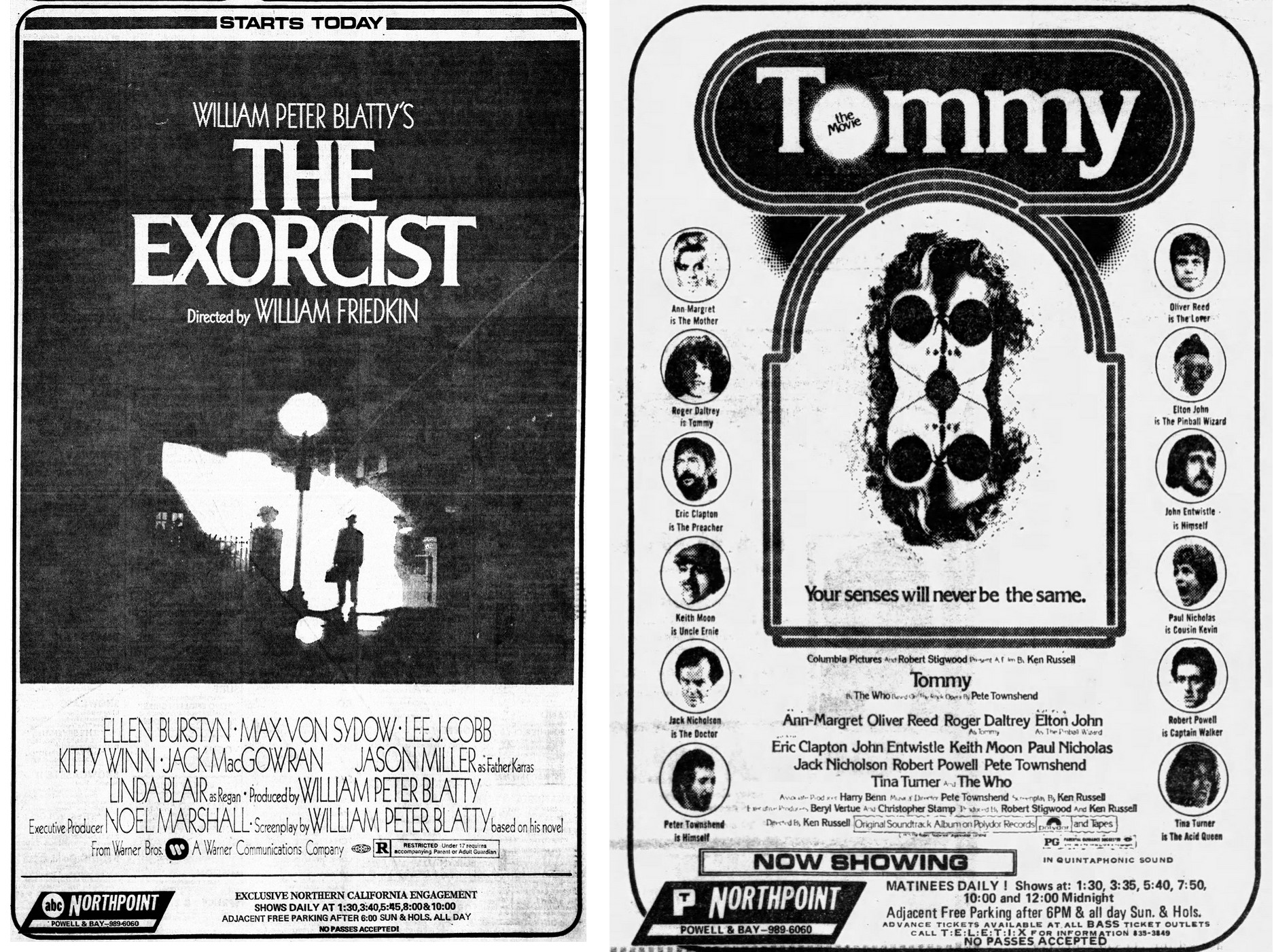
For a time, I kept a scrapbook filled with newspaper ads for the movies I'd seen. The Northpoint Theater in San Francisco was one of my favorite moviegoing venues. I was thrilled to see The Exorcist (1973) and Tommy (1976) when they made their Bay Area debuts there. 


But so far, all the modes of movie memory-making I've covered have been of the visual-aids variety: items that work like sentimental signposts designed to jog my memory along a recollection map whose coordinates and points of reference it remained largely up to me to determine (i.e., they could only trigger memories I'd already backlogged).

Movie soundtrack albums were another thing entirely. I speak not of the soundtrack albums for movie musicals, which are both culturally accessible (the source of many top 40 hits) and require no real affinity for the film itself (e.g., the double platinum LP success of the otherwise flop musical Xanadu). No, I speak of the limited, almost cult-like appeal of the original soundtrack album devoted to the instrumental, chiefly orchestral, musical score composed for a dramatic or comedic film. Not everybody has the stomach for long play records devoted to the non-diegetic (outside-of-story) thrills of background themes, melodic excerpts, and music categorized as incidental or transitional.

Listening to music composed for the express purpose of (imperceptibly) enhancing a film's mood and influencing the viewer's emotional response to images on a screen may not be everyone's taste, but whether it was music for a car chase, love scene, or comic interlude; for the longest time, motion picture soundtrack albums were the only way to really take a movie home with you.

Some of my happiest memories are of lying on the living room (shag) carpet in front of our wood-paneled TV/Radio/Hi-Fi record player console behemoth (with space for album storage!), listening to soundtrack albums I rented from the public library. Remembering a film is nice—and that's where memorabilia and souvenirs come in—but listening to a movie's soundtrack LP, with eyes closed and headphones on, is more than recollection; it's rediscovery.
By listening to music you most likely felt but never really heard (if the movie did its job of keeping you engrossed), you got to replay and relive a cinema experience in your mind. There's a definite geek element to this method of making a movie memory (the scores to a great many '60s comedies sound like music for a cartoon or bad TV sitcom). But nothing compares to soundtrack albums for their ability to inspire new dreams while revisiting the old.
I don't know if it's true, but it has always felt like I grew up during the golden age of movie music. Theme songs from motion pictures were all over the radio and TV variety programs. My earliest memories of the kind of movie music played around my house are not of movie soundtrack albums, but albums devoted to cover versions of popular songs from movies. My mom had a crush on Tom Jones, and though she played his What's New, Pussycat? album to death, I don't remember a single other song on it.

My dad's crush was on Nancy Wilson, so I often heard this album. It included the songs EVERY popular singer of the time recorded—Moon River, The Days of Wine & Roses, and Alfie—plus the ubiquitous More (theme from Mondo Cane), which to this very day always makes me think of the 1963 film Toys in the AtticYou see, my folks took us with them to a Drive-In movie to see the Dean Martin starrer Toys in the Attic (Dino was another of my mom's crushes...she really had a "type," didn't she?), and it was there that I was traumatized by the trailer for the gross-out shock documentary Mondo Cane.

As much as I loved movies, when I was young, thanks to the proliferation of light classical and easy-listening LPs like these, movie scores carried the stigma of being associated with Muzak and was thought of as "elevator music." There was a time when you really couldn't go anywhere without hearing Lara's Theme from Doctor Zhivago (Somewhere My Love), or the Theme from Moulin Rouge (Where Is Your Heart?).  

Today, I carry these with me on my iPod. Time has been the least forgiving to the soundtrack of Barefoot in the Park (1967)But nothing evokes 1969 San Francisco for me like The Magic Christian soundtrack. Midnight Cowboy is perhaps my favorite complete score of the four. To this date, I've never seen The Bliss of Mrs. Blossom, but when I was 10, I was a fan of The New Vaudeville Band (Winchester Cathedral), so their presence on this LP was enough to make the gamble worthwhile.

TOP 20 Motion Picture Soundtrack Albums
(not a list of the "best" albums - a list of albums that made me happy)


I simply marvel at the many things that technology has made readily available to the modern film buff. Movies can be viewed in laser-sharp Blu-ray within months of their theatrical releases, complete with deleted scenes, alternate endings, informative commentary tracks, and director's cuts. There's untold online access to stills, posters, storyboards, soundtrack cuts (no need to listen to the entire album!), early script drafts, interviews, poster galleries, and all manner of behind-the-scenes trivia and factoids. I could never have imagined even a fraction of all this growing up.
And while I'm sure my 12-year-old self would have been over-the-moon enraptured had any of this been available to me during my formative film fan years, my older and wiser present-self knows better.
I don't know how it came about, but my older sister Christy received an invitation to an advance screening of Star Wars on May 1st, 1977 (the film began its official run on May 25, 1977) and asked me to be her guest. We both got George Lucas to autograph our invitations, but I was the only one foolish enough to sell it on eBay years later, so that's why the one inscribed to my sister appears here.

I know that my lifetime love affair with movies has always been nurtured by the courtship phase. The anticipation, the counting-the-days-until-release excitement...all followed up by the exquisite agony of wondering when you'll get to see the movie again, and hoping your memories will sustain you until then. 
The elemental unavailability of movies--no attendance allowed on school nights, having to take a bus to get to them, seeing them exclusively in cavernous movie palaces resembling churches--gave them their mystique and made them special. All of this fed into what I call "the cult of longing"—those myriad rituals I engaged in (posters, souvenirs, memorabilia, records, etc.) to best make a lasting memory of a favorite film. 
Over the years, I've found that what this method lacks in instant gratification is more than compensated for by its ability to create a bridge linking the magic of cinema to the durability of dreams.
The Alhambra Theater on Polk Street in San Francisco - The site of my first job
I moved to LA in 1978, but took this photo in 1981 during a visit


BONUS MATERIAL
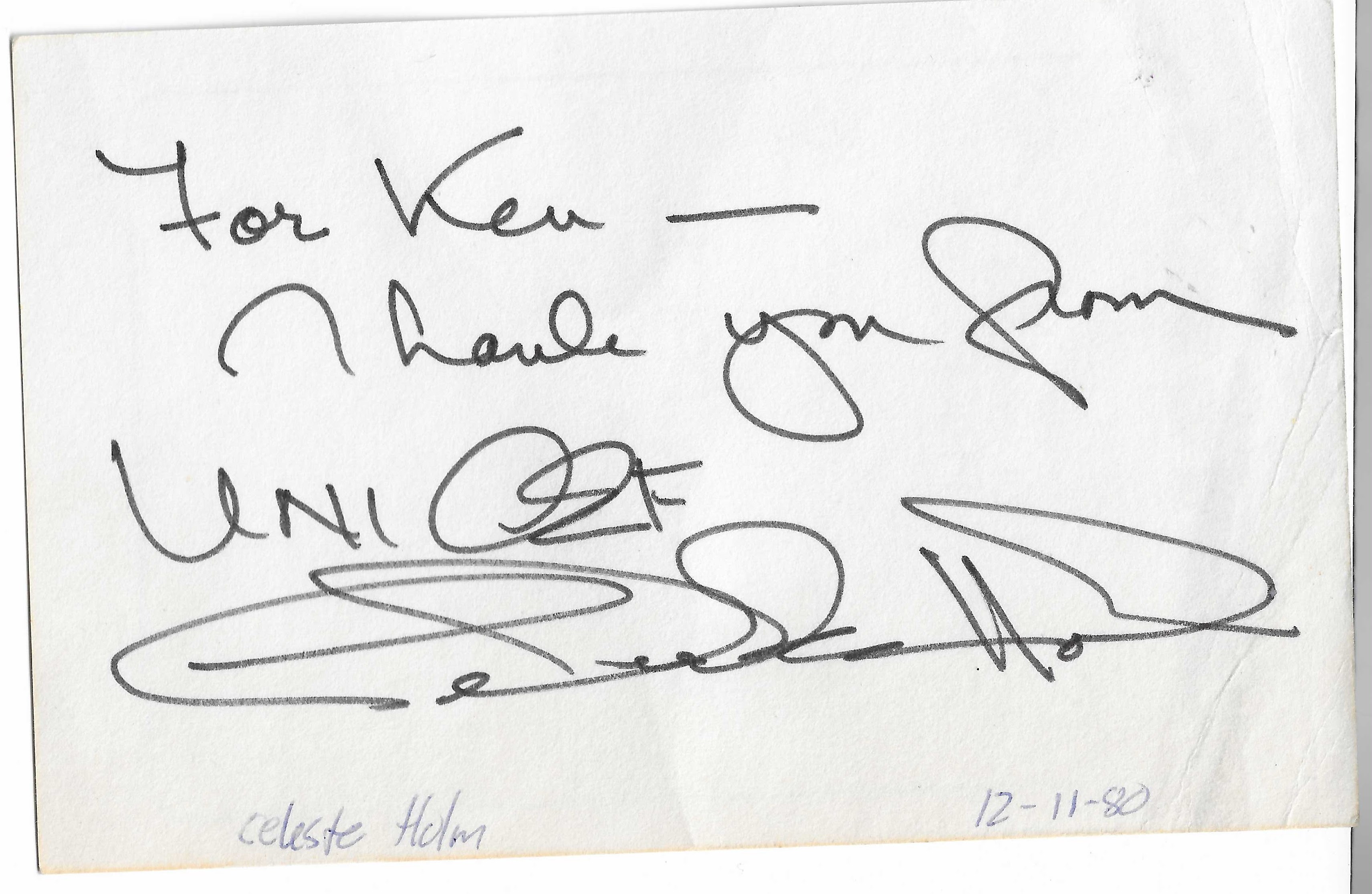
Moving to Los Angeles allowed me to add autograph collecting to my arsenal of memory-makers. I've still not quite adapted to the celebrity selfie.
Celeste Holm - 1980

Alfre Woodard - 1990s


Copyright © Ken Anderson    2009 - 2017