Tuesday, February 12, 2013

LAST SUMMER 1969

The occasion of a recent TCM screening of this forgotten minor masterpiece from the late ‘60s jogged my memory back to when the film collaborations of the matrimonial/professional team of director Frank Perry and screenwriter Eleanor Perry represented the bright promise of the New Hollywood. Their films, David and Lisa (1962), The Swimmer (1968), and especially the excellent Diary of a Mad Housewife (1970), felt almost European in their blending of arthouse aesthetics with exploitable, mainstream commercial themes.  
Goodbye, Gidget. Farewell, Frankie and Annette
An awful lot had changed since the release of the final Beach Party movie in 1966

I was 13 years old when Last Summer, and, in truth, I had no business seeing so adult a motion picture at such a young age. I may have had no business seeing it, but I wanted to see it like crazy. But thanks to having a much older sister who served as the accompanying “adult guardian” making possible my admission to a slew of age-inappropriate movie farein previous years—Barbarella, Rosemary’s Baby, Bonnie and Clyde, and Secret Ceremony, to name just a few—I had already convinced myself that I was far too mature an adolescent to waste time on the movies marketed to my age demographic. 
The MPAA movie rating system was in its infancy then (when G, M, R, and X were the designations), and I had self-seriously deemed that anything below an “M” was simply not worth my time. After all, I wasn't a child!
Of course, I know now that this attitude was as much born of fervid sexual curiosity (aka, adolescent horniness) as intellectual inquisitiveness, but when you’re that young, there really isn’t all that much of a difference between the two.
Last Summer premiered in New York with an X-rating. By the time it opened
in San Francisco two months later, it had been edited down to an R-rating

The release of Last Summer was on my radar because I had read that it was to be given an X-rating, and back then, to me, X-rated meant sophisticated. To my mind it was a rating that, in keeping with the critical and boxoffice success of the recent X-rated release Midnight Cowboy (1969), held the promise of being just the start of a whole slew of Hollywood movies made for grown-ups (and me, of course) that were free to tell important, contemporary stories unencumbered by the constraints of censorship or the worry of meeting the bland criteria of "wholesome family entertainment."

And indeed, for a time, that appeared to be the case. There came a string of films with intriguingly elevated themes that fell under the X-rating umbrella: Greetings! (1968), The Damned (1969), Medium Cool (1969), A Clockwork Orange (1971), Last Tango in Paris(1972). But soon the “X” rating was appropriated by the porn industry, and whatever chance an "X-rating" had of signifying hands-off censorship interference was short-lived.  
Barbara Hershey as Sandy
Richard Thomas as Peter
Bruce Davison as Dan
Catherine Burns as Rhoda

I saw both Midnight Cowboy and Last Summer within months of each other, and the reason I'm harping on the whole "X-rated" thing is that it became part of Last Summer's lore, and contributed to a lot of misremembering on my part. At the time, everyone was talking about these two high-profile, controversial, X-rated features. John Schlesinger’s Midnight Cowboy maintained its X for the duration of its run, but Last Summer, after playing briefly in NYC with the "X" tag, Frank Perry agreed to delete a couple of swear words and a few frames from the film's harrowing climax to give his film an R-rating before going into wide release. 
What TCM screened a few weeks ago was said to be the R-rated theatrical release from 1969, and likely the same film I saw back then. But over the years, there have been so many edited versions of Last Summer in circulation (remarkably, I don't think it ever had a VHS or DVD release) that I have my doubts. This isn't helped by my having two bootleg versions of the film, one running about a minute and forty some seconds longer than the other. (The extended time seems due to longer shots in the final sequence. The longer version is recognizable by the inclusion of Bruce Davidson's line "She's gonna swallow her braces," after Barbara Hershey's remark "You look like you're gonna choke.")
This shot, part of an extended verbal exchange, was missing, along with several other brief cuts
to this sequence, from the version of  Last Summer broadcast on TCM 

So, despite what I do and don't remember about the version I saw back in 1970, at least we know there are at least two different cuts of Last Summer floating around. 

Both Midnight Cowboy and Last Summer received high praise from critics, Midnight Cowboy going on to make history as the first (and to date only) X-rated movie to win an Academy Award for Best Picture. But somehow, Last Summer, despite having garnered a Best Supporting Actress nod for newcomer Catherine Burns, and launching the long careers of its other young stars, managed to fall through the cracks. All but forgotten due to the film's unavailability. 
Affluent teens vacationing on Fire Island with their disinterested parents 
bond after saving the life of an injured seagull

With its title a darkly ironic harkening back to the innocent, sun-and-sand Gidget movies of the sixties, or those sexually innocuous Frankie & Annette Beach Party romps, Last Summer is perhaps one of the harshest eviscerations of adolescent social dynamics I've ever seen. Neither a youth-pandering idealization of the Pepsi Generation of the sort typified by late-'60s films like The Graduate and Easy Rider, nor one of those nostalgically sentimental coming-of-age films that would later flourish in the '70s (The Summer of ’42, The Last Picture Show, American Graffiti), Last Summer is adolescence presented as a state of proto-barbarism. Where the youthful cry for "freedom" is met with the notion that, if left to their own devices, would the Love Generation be any less savage than the Over-30 set?
In a scene emphasizing Sandy's sexual acquisitiveness and dominance over the boys' relative sexual hesitancy, Sandy and Dan come across two lovers making out on a remote stretch of beach. When it's discovered that the lovers are men, Dan wants to leave, but Sandy insists they stay and watch. 

A trio of teens vacationing with their parents on Fire Island strike up an intimate friendship when callow, future fratboy Dan (Davison), and sensitive go-alonger Peter (Thomas) come upon sexually precocious brainiac, Sandy, tending to a wounded seagull on the beach (Sandy: Well you asked me, so don’t think I’m boasting, but my IQ is 157.”) Bonding over their shared isolation, sexual restlessness, and an overweening, heretofore unplumbed disdain for the feelings of others, the threesome find the dynamics of their tightly-knit group challenged with the appearance of Rhoda, a bright but shy and awkward outsider who insinuates herself into the fold.
The vulnerable don't stand much of a chance with this crowd. Rhoda is introduced committing a simple act of deceny (which already makes her a misfit): she tries to get the trio to stop tormenting the seagull they're attempting to turn into a pet.  

Plump and pale to their tall and tawny; braces-wearing and happy to act her age to the trio’s fevered acceleration into adulthood; it’s fairly obvious from the start that Rhoda’s emotional self-assurance and killjoy, sober decency is a wrong mix for this crowd. Yet the point is keenly made by the film that in adolescence, the pain of loneliness can be so acute that even the belittling company of those who fail to see your value is sometimes preferable to being alone.
In Rhoda, Sandy finds another "project" ...like the seagull. 
Here, Rhoda models the update from her "old lady" bathing suit 

Last Summer's poignancy is derived from the realization that, what with all four teens coming from broken or troubled homes, they could have been helpful to one another, and that the summer would wind up being memorable to them for a lot of good reasons. But, being at its heart an existential parable on power, hurt people hurting others, and the question of whether cruelty is a choice or an instinct, Last Summer leaves our young protagonists irrevocably changed, and unlikely for the better. 
"You have an unmapped face. It doesn't come right out
and say what's going to become of it."
The gentle connection that Rhoda and Peter begin to develop stands to threaten the dynamic of "the trio." 

WHAT I LOVE ABOUT THIS FILM
 Like so many of my favorite films from this era: They Shoot Horses, Don't They?, Midnight Cowboy, Puzzle of a Downfall Child, even Rosemary's Baby; Last Summer is for me a marvelous example of how fascinating American movies were becoming in the late-60's, early-'70s when they began to venture into realms of storytelling that were not overtly tethered to their commercial potential. 
Sure, there's always the marketable angle of sensationalism, and films like Last Summer were more than willing to make their boldness and daring a part of their marketing. 
But what made the films of this era different from those released even a few years earlier (and, sadly, just a decade later) was their willingness to go to the darker places of the American myth and challenge our concepts of ourselves and the world we live in. 
So often, I find movies today tend to feed us comforting images of ourselves and set out to reinforce tissue-thin myths we harbor about everything from gender politics to racism. Although I don't require it in every film I see, I must say I enjoy it when movies hold up a mirror to American culture that reveals the decay behind the gloss, proposing, in the exposure, that we have the potential to do and be better.  
Again, the vulnerable are seen as targets, not subjects of empathy
Last Summer doesn't shy away from the exposing the privileged arrogance of the of these blond teens who, sheltered in their all-white enclaves make comic/idiotic jokes in the contrived slave dialect of Gone With the Wind, or, in this painful scene, make blantantly racist jokes at the expense of Anibal Gomez (Ernesto Gonzalez), a sweet and lonely Puerto Rican computer date set-up for the reluctant Rhoda.

Movies in the '60s/'70s were comfortable with revealing the darker shades of human nature. In fact, one of my strongest memories from this period in filmmaking was the distinct impression I was never going to see a movie with a happy ending again. I enjoyed seeing movies that made me think, made me feel...but at times it seemed as if every movie released during my teens ended in some devastating tragedy. Even the musicals were downers: Sweet Charity!

PERFORMANCES
Relying perhaps on type-casting and using his young cast's relative acting inexperience to their benefit (Last Summer is the film debut of all but Barbara Hershey, who appeared in Doris Day's last film, With Six You Get Eggroll, just the year before), Frank Perry gets natural and surprisingly complex performances out of everyone, particularly Catherine Burns. Although lacking in the sort of easy, obvious camaraderie Peter Bogdanovich was able to achieve with his cast in The Last Picture Show--most apparent in a visibly forced, "beer as truth serum" sequence that gives credence to Hershey's claim years later that despite the intimacy required of their roles, the cast didn't become close during the making of the film--each actor achieves a kind of heroic bravery in allowing themselves to be presented so honestly and unpleasantly.
When Last Summer was released, the entire cast was applauded for their performances, but it was Catherine Burns who emerged as the breakout “star,” garnering the lion's share of the film's best reviews and Last Summer's sole Academy Award nomination. Though reunited with Richard Thomas in 1971's Red Sky at Morning (a film I haven’t seen), Hollywood didn't seem to know what to do with her, and so after being wasted in a few TV movies and disposable roles in episodics, she bowed out of the industry for good, becoming a published author. She passed away in 2019.
The role of Mr. Caudell, Sandy's sexual assaulter dubbed "Snow White" due to his inability to tan, is played by character actor Peter Turgeon. Recognizable to fans of Airport (1970) as the annoying passenger who eventually gets slapped by a priest. 

Barbara Hershey's assured and dynamic performance as the dreamgirl sociopath is one that has really stayed with me over the years. Carnal, conniving, straightforward, and deeply troubled, I think her characterization is so genuinely terrifying because she is just such a recognizable brand of emotional/intellectual bully. Long a favorite of mine and a definite object of a boyhood crush, Hershey's impressive and enduring career includes BAFTA and Oscar nominations. 
Barbara Hershey (born Barbara Hertzstein) briefly changed her name to Barbara Seagull out of guilt surrounding the death of the seagull that was accidentally killed during the filming (the scenes involving the bird are another reason why Last Summer is a very unsettling affair).
Poster for the 1975 heist film Diamonds, featuring Barbara Hershey with her "Seagull" billing

THE STUFF OF FANTASY
Perhaps the parallel symbolism is all too heavy-handed for some, but what I loved about this film in 1969 and what still stands up marvelously in 2013 are the parallels drawn between the film's early sequences involving the attempt to rehabilitate and then train the wounded seagull, and the introduction of the character of Rhoda into the group. The foreshadowing of the film's agonizing denouement is as clear-cut and unalterable as a self-fulfilling prophecy, but what grips me is what lies behind why it happens at all.

To see this film now is to understand what occurs inside any group or individual in power when threatened with the loss of that power. Whether it be the behavior of the GOP in the last election or the reluctance of certain states to grasp the inevitability of marriage equality, it all fits and paints an ugly portrait of cowardice cloaked in entitled domination. To find all of this within a teenage coming-of-age film is just brilliant, and provides one more reason why it's such a shame this film is so hard to track down. 
That Sandy would most likely be happiest were Dan and Pete to be somehow merged into one person feeds the already heady homoerotic sexual tension that exists within this tripartite friendship.


THE STUFF OF DREAMS
For years on the internet, there have been reports of Last Summer finally getting a DVD release. Its reemergence on cable TV and a recent American Cinematheque screening of a long-lost, uncut 16mm print hint that perhaps one day soon this might very well be the case. I certainly hope so. 
Not only is it one of Frank and Eleanor Perry's best films (and Frank Perry doesn't deserve to be remembered in perpetuity for being the man who gave us Mommie Dearest and Monsignor,  does he?), but I also think it's one of the more important and representative films of a significant era in American film.  
Scene from "Last Summer" (1969)


BONUS MATERIAL
I read Evan Hunter’s 1968 novel Last Summer not long after seeing the film. Eleanor Perry’s screenplay is surprisingly faithful to the source material, and it's every bit as disturbing as the film. The novel provides a bit more backstory to the characters and is told in the form of a flashback memory recounted by an emotionally shattered Peter to his psychiatrist. In 1973, Evan Hunter wrote a sequel to Last Summer titled Come Winter. I don't know if any significance should be placed on the fact that while I read it much more recently than Last Summer, I nevertheless can't recall a thing about it. 

A deleted scene from Last Summer featuring Ralph Waite as Pete's father. Waite and Thomas would go on to appear on TV as father and son for five seasons of The Waltons.

The Manor (2021)
Bruce Davison and Barbara Hershey were reunited as co-stars for this Gothic horror film set in a retirement home. Oh, if only some clever writer had thought to make this an extended sequel to Last Summer. Would Dan and Sandy have changed?  Would that summer have scarred them for life? 


Copyright © Ken Anderson  2009- 2013

Thursday, February 7, 2013

PUZZLE OF A DOWNFALL CHILD 1970

I've a feeling an individual can easily gauge what his or her overall response to this film is likely to be simply based upon how one reacts to its title. If Puzzle of a Downfall Child strikes you as a potentially profound, enigmatically poetic title conjuring up images of Paradise Lost and existential disillusion, you’re likely to fall in love with this long-considered-lost exemplar of European-influenced, '70s “personal statement” cinema. On the other hand, if the title reeks of self-serious pretentiousness and needlessly arty ambiguity…well, little about the film itself is likely to alter that perception.

Me, I fall a little into both camps. For one, I've always been crazy about the title. Perhaps that's because I was 13 years old when the movie came out and the title sounded just gloomily cryptic enough to appeal to my adolescent taste for high-flown self-dramatization. (In an interview, director Jerry Schatzberg has stated that the title alludes to a plot element involving an abortion that was deleted in an early draft of the screenplay.) I adore Puzzle of a Downfall Child for its introspective examination of the elusiveness of happiness and the human desire to connect in the face of reality-distorting conceptions of image, sexuality, self-worth, and success. In the telling, few of the film’s insights are very acute, but there’s a psychological authenticity to the screenplay and performances which significantly mitigate the sometimes arthouse excesses of the film’s visual style.
Which leads to camp #2. As much as I love Puzzle of a Downfall Child and believe it to be both a beautiful and moving film, I’m the first to admit that at times it can feel like a parody of a '70s art film. The debut effort of photographer turned-director Jerry Schatzberg, Puzzle of a Downfall Child falls prey to the minor sin of over-determined significance. There’s a kind of naïve foolhardiness to be found in acts of absolute sincerity, and if Puzzle of a Downfall Child suffers from anything, it’s from a heartfelt conviction it is saying something “important” about the human condition. To some, such ponderousness can come off as pretentious, humorless, or just plain exasperating. But me, I’ll take a self-serious film that tries to be about something over today’s cynical, eye-on-the-boxoffice, market-research product any day.
Faye Dunaway as Lou Andreas Sand
Barry Primus as Aaron Reinhardt
Viveca Lindfors as Pauline Galba
Roy Scheider as Mark 
Faye Dunaway plays Lou Andreas Sand (nee Emily Mercine), an emotionally fragile former high-fashion model who has retreated to a solitary beach house on Fire Island following a crippling nervous breakdown. Visited by long-time photographer friend and former lover Aaron Reinhardt (Barry Primus), Lou recounts her troubled life in a taped conversation Reinhardt hopes to fashion into a film. With her life revealed in flashbacks that come at us in stylized and realistic non-linear stretches devoid of obvious hints as to their veracity as memory, fantasy or both; Lou reveals herself to be the most unreliable of narrators. Yet the tone of these mental images, playing out like scrapbook pages torn from an album and reassembled, expose the truth of the woman, if not always the truth of the events themselves. It's a fascinating narrative path made all the more so due to Puzzle of a Downfall Child being a film constructed in much the same manner. That the movie creates for us a sense that we are watching just the sort of film Primus' character is likely to assemble from his talks with Lou is just one more piece of Puzzle of a Downfall Child 's continually self-referential puzzle. 
Two magazine covers photographed by Jerry Schatzberg
Left: Anne St.Marie -1956 / Right: Faye Dunaway - 1968

Director Jerry Schatzberg, who had worked for more than 20 years as a photographer for magazines like Vogue, Esquire, and McCall's, based Puzzle of a Downfall Child on taped interviews he conducted with one of his favorite subjects, 1950s supermodel Anne St. Marie. St.Marie, like her film counterpart, retired from modeling after suffering a nervous breakdown. To further the whole wormhole effect of this enterprise, Schatzberg, who was rumored to have had an affair with St. Marie (as does his screen doppelganger, photographer Aaron Reinhardt with Dunaway's Lou Andreas Sand) in real life photographed Dunaway for many fashion magazines, and for a time the two were engaged to be married. Their relationship had already dissolved before Puzzle of a Downfall Child went before the cameras.
"If one can't keep some friends somewhere, then something is really wrong."

WHAT I LOVE ABOUT THIS FILM
I think perhaps my favorite thing about Puzzle of a Downfall Child is that it combines two of my favorite film genres: the '70s trying-to-find-oneself character drama and the '40s suffering-in-mink women’s weepie. How perfect is that? When I first saw this film, Faye Dunaway’s too-sensitive-for-this-world fashion model was an oasis of estrogen ennui in the testosterone-leaden desert of male-centric '70s films romanticizing male identity crises and masculine existential moments of reckoning. To my taste, there was a decided oversupply of movies featuring the likes of Jack Nicholson, George Segal, Richard Benjamin, or Elliot Gould grappling with the meaning of life, while an uncomprehending female (usually a sweet-natured dumbbell, and almost always played by Karen Black) stood around on the sidelines. Aside from the vastly inferior (by comparison) Jacqueline Bisset drama, The Grasshopper (1969), Puzzle of a Downfall Child was one of the few films from this era to grant a female character an equivalent navel-gazing opportunity.
To update Easy Rider's famous tagline, Puzzle of a Downfall Child could have been subtitled: "A woman went looking for America and couldn't find it anywhere."

To its credit, Puzzle of a Downfall Child tries to find the common thread of humanity in the privileged-class despair of Lou Andreas Sand. And as embodied by Dunaway and captured by Schatzberg’s loving camera lens (actually cinematographer Alex Holender of Midnight Cowboy), Lou may never look less than exquisite (even when in the throes of a foaming-at-the-mouth nervous breakdown), but her pain is recognizable and real.

Have you ever seen an old detective movie or TV show and marveled at the perversity of (male) cops and reporters at a murder scene going on and on about how beautiful or desirable a female corpse was? I can't count the number of films I've seen where men stand over a dead woman's body lamenting the "waste" of a beautiful woman and how particularly tragic it is that said woman, so pretty or sexy in life, is now dead. It’s like there’s this overriding mentality that a woman’s looks and physical appeal matter even in death. Or worse, that one can be too beautiful to die...as if the loss of life is sad, but the tragedy is compounded if the corpse is a looker. 
Beauty: Fetishism and Objectification
Puzzle of a Downfall Child sensitively addresses the high value we, as a culture, place on beauty, and the price exacted on those who fall prey to it. In placing this character drama in the appearance-fixated world of fashion photography, Schatzberg and screenwriter Carole Eastman take an insightful look at a woman whose entire existence and sense of self-worth is tethered to her beauty. Whose need to please and always be seen as desirable under the male gaze is both a desperate, deep-seated search for approval and a profound denial of self. The film's definitive narrative thread calls attention to the pervasiveness of male exploitation and the vulnerability/susceptibility of the female form.
Distorted Image
Troubled Catholic Schoolgirl Emily Mercine attempts to lose herself by adopting a pretentious name (perhaps borrowed from Nietzschean psychoanalyst Lou Andreas Salome) and engaging in casual sex with father-figure strangers. Like a character out of Damon Runyon, Lou Andreas Sand speaks in a mannered style totally devoid of contractions, and compulsively re-imagines events of the past in order to protect her fragile image of herself.

PERFORMANCES
Faye Dunaway’s participation was instrumental in getting Puzzle of a Downfall Child to the screen, and her passion for the project is evident in every frame. And it’s a good thing too, because to the best of my recollection there isn't a single scene in which she does not appear. Mind you, I'm not complaining, for in much the manner that Liza Minnelli is so good in Cabaret that she makes you forget “Liza Minnelli: The Home Shopping Network Years”; Faye Dunaway so thoroughly blows me away in Puzzle of a Downfall Child that I'm reminded of everything her career promised before the whole Mommie Dearest / voicemail meltdown thing. One of my favorite but most problematic actresses (you have to have a taste for her mannerisms), Dunaway has every reason to be very proud of her work in this. After Bonnie & ClydePuzzle of a Downfall Child ranks as my all-time favorite Dunaway film. She is phenomenal in it.


THE STUFF OF FANTASY
I tell everyone, even if you don't have the patience for the entire film, just watch the first 15 minutes. The sequence chronicling Dunaway as a fledgling model navigating the battlefield of her first fashion shoot is cinema gold. Shot with an eye for detail only possible from knowing this world very well, Schatzberg peels back the illusions we hold in our America's Next Top Model preoccupation with the fashion industry and reveals the dehumanizing reality. Sure it's satirical, sure it's depicted from the overwrought perspective of the heroine; but from the performances, the dialogue (tellingly, Lou's voiceover describes the men on the set all looking at her as if they were sex maniacs. The visuals reveal her to have been largely ignored), and the stylish cinematography, this sequence is a great example of MY kind of moviemaking.
Dunaway reacts (I'll say) to being required to share her close-up with a live falcon. This terrifying sequence recall actress Tippi Hedren's accounts of working with Hitchcock on The Birds.


THE STUFF OF DREAMS
One of the good things about viewing an old film (and at 43 years-old Puzzle of a Downfall Child definitely qualifies) is that one gets to watch it in an environment entirely different from that in which it was created. Puzzle of a Downfall Child bombed in part because it came at a time when audiences were wearying of the glut of European-influenced, tarnished American Dream films that filled theaters after the breakthrough years of 1967. When viewed from the comic book / 3-D / blockbuster perspective of today, the film looks nothing short of miraculous.
Throughout her modeling career, Lou Andrea Sand compiles a list of photographers she refuses to ever work with again due to their abusive behavior. Boldly written in red on this list is the name of the film's director, Jerry Schatzberg. In her memoir, Looking for Gatsby, Faye Dunaway explains that this was an improvisational impulse on her part born of a particularly difficult time the director gave her after actor Marcello Mastroianni (the man she left fiance Schatzberg for) visited her on the set. Schatzberg liked the touch and kept it in the film.

As a culture, we’re guilty of attributing great profundity to the existential midlife traumas of male characters in films, while women undergoing the same are dismissed as merely neurotic. (I don’t know where I read it, but someone once observed that The Graduate missed the boat in focusing on the petulant Benjamin Braddock when the film's most compelling story and most interesting character was Mrs. Robinson and her midlife dissatisfaction.) It’s difficult not to think this subtle double standard played into the critical response to Puzzle of a Downfall Child, but as good as the film is (and I think it’s a really excellent film) there’s no ignoring that it falls into the usual traps that beset movies that ask us to feel sorry for the beautiful people.
Film is a storytelling medium and all manner of human experience should be explored. But films like Puzzle of a Downfall Child seem to forget why movies exist and who attends them. No matter how masterful the film, it’s difficult to ask an audience to listen to a woman as breathtakingly beautiful as Faye Dunaway complaining about how unhappy she is in her (perceived glamorous) job as a fashion model, and how empty she finds her life (after amassing enough wealth to live in financially independent solitude in a spacious beach house). 
We all know that the rich and beautiful can suffer as much as the rest of us, but any film that attempts to dramatize a shared humanity with people whose lives offer far more options than those of the average person has to walk a precarious tightrope. If the world is too glossy, the people too lacquered, it can actually end up glamorizing that which it's trying to vilify. Ultimately sending a message similar to the one expressed by those cops in the old movies bemoaning the fact that certain people are  just “Too beautiful to suffer, too lovely to die.”
As of this writing, The DVD of Puzzle of a Downfall Child is currently only available in France (released Feb. 2012), but every year more and more obscure films are getting "made to order" releases, hopefully this will be one of them.
So, whether you take the film to your heart (as I did), or wish to wallow in its camptastic splendor  (Puzzle of a Downfall Child is an exquisite, sumptuous-looking film that has a scene involving a toilet that is sure to send Mommie Dearest fans into wild ecstatics), this artifact from the days when movies sought to do more than make Variety's Top Ten weekend boxoffice list, has a little of something for everybody.

No matter how you prefer your Dunaway, overdone and theatrical or touching and deeply affecting, Puzzle of a Downfall Child is a lost miracle of a film that is worth taking the time to discover (or rediscover).
"One only breaks oneself apart in order to put oneself back together again...better."

To view some of Jerry Schatzberg's magnificent photographs, visit his website HERE

Faye Dunaway and Clark Burckhalter in a clip from "Puzzle of a Downfall Child" (1970)

Copyright © Ken Anderson  2009 - 2013

Thursday, January 31, 2013

GAMES 1967

Sometimes being a movie star just means having enough “brand name recognition” to bring to each movie a kind of distinct, firmly established name-association (a personality cachet, if you will) fully-formed and locked in place from a previous film. 
For example: to a large segment of the population Mia Farrow was and always will be Rosemary Woodhouse of Rosemary’s Baby. The films See No Evil (1971), The Haunting of Julia (1977) and the 2006 remake of The Omen all banked on the public associating Farrow with the macabre and horrific. None perhaps so blatantly or swiftly as Joseph Losey’s difficult-to-market 1968 psychological thriller Secret Ceremony, which was released only four months after Rosemary’s Baby opened. Although the film starred Hollywood heavyweights Elizabeth Taylor and Robert Mitchum in their only screen pairing, ads emphasized what was then the film’s one sure-fire property: Mia  Farrow - “More haunted than in Rosemary’s Baby!” the posters screamed.  
Satan Place
 Occult rituals are just one of many perverse diversions in Games

After the success of Halloween (1978) critics began hailing director John Carpenter as a worthy successor to Alfred Hitchcock. Hoping to further encourage such comparisons, Carpenter cast perennially Hitchcock-associated actress Janet Leigh in a thoroughly arbitrary role in his 1980 film The Fog. Janet Leigh, who should be commended for not having turned the entirety of her latter years into one long series of stunt-casting parts cashing in on her iconic Psycho role, did allow her image to be exploited just one more time - in the 1998 Halloween sequel, Halloween H20: 20 Years Later (check out IMDB’s Trivia section for details) although it must be said these nothing roles at least afforded her the opportunity to appear onscreen with real-life daughter Jamie Lee Curtis.
Desensitization
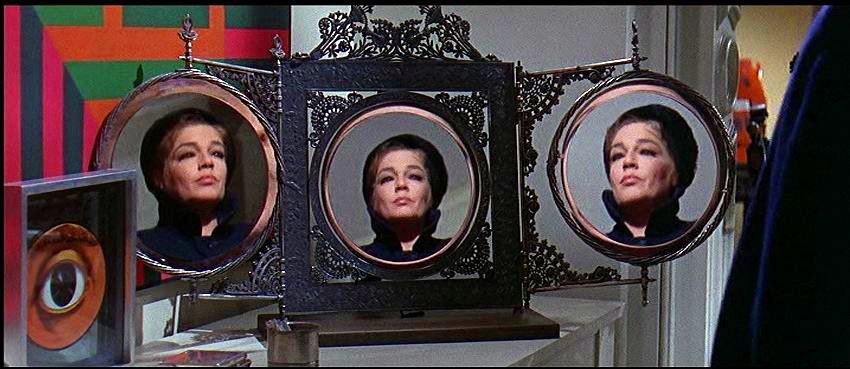
A well-appointed game room features violent Roy Lichtenstein pop-art and a pinball machine that awards points for driving fatalities

In 1968, if American audiences knew much about French film star Simone Signoret at all (and they didn't) it was on the strength of three films: her Oscar- winning role in Room at the Top (1959); her Oscar-nominated turn in Stanley Kramer’s prestige flop, Ship of Fools; and… most popularly and most likely, the highly acclaimed and influential thriller Diabolique (1955). Internet sources maintain that the starring role of Lisa Schindler, the mysterious visitor in Games, was originally written for Marlene Dietrich, and when producers balked, the role was offered to Jeanne Moreau, who also declined. All of which may well be true. But after looking at this clever thriller full of twists and mysterious turns, the overwhelming evidence leans towards my belief that Games was conceived and written expressly to capitalize on and exploit the American public’s familiarity with Signoret’s starring role in Clouzot’s bloodcurdling French chiller.
Simone Signoret as Lisa Schindler
Katharine Ross as Jennifer Montgomery
James Caan as Paul Montgomery
Like most good thrillers, the premise of Games is marvelously simple. A well-to-do but eccentric young couple  who like to engage in elaborate games and practical jokes (Caan and Ross) meets their match when a mysterious French stranger (guess who) enters their lives. The couple, both blasé dilettantes dabbling in chic nihilism, prove no match for the genuine article.
Brando-ish 70's TV stalwart, Don Stroud (who five years later would appear as a nude centerfold in Playgirl magazine) plays Norman, the oversexed box boy. Another player in Games 


WHAT I LOVE ABOUT THIS FILM
Compensating perhaps for all those years of hyperactivity in my youth, I’ve discovered of late that I’m remarkably adroit at being sedentary. It's a revelation to me that in my dotage I find I no longer go in search of thrills, but prefer instead for my thrills come to me. Ill-disposed as I am to amusement park rides, fast cars, or any activity calling for the deployment of adrenaline, I have become a huge fan of armchair adventure. I love mysteries, suspense thrillers, horror films (horror as in dread, not gore) and movie plotting that stays one step ahead of me. Even when a film has plot twists which can be figured out if one really puts their mind to it (as some claim to be the case with Games), I so enjoy the big “reveal” in these kinds of movies that I've learned over the years how not to spoil my own fun. I employ a subtle form of self-hypnosis, allow the plot to unfold before me and just let myself surrender to the director’s pace, trying not to put the pieces of the puzzle together unless the film leads me there first.
Identity and Illusion
Games is almost theatrical in its construct, as it’s sparsely populated (four principal characters) and takes place primarily in a single location (the tony townhouse of Paul and Jennifer Montgomery). Tension is derived from the uneasiness of having a cast of characters, none of whom we’re told very much about but all overtly fond of playing mind-games, interacting in both real and contrived situations. As it becomes increasingly difficult to ascertain whether a game has begun, ended, or is underway, it soon dawns that the film itself is but another of the games. One that we in the audience (like several of the characters in the movie) weren't aware we were playing.

PERFORMANCES
Regrettably, for all the fun to be had in watching Games (like the 1972 film adaptation of Anthony Schaeffer’s Sleuth, its pleasures don’t diminish even after its surprises are revealed) I can’t say it’s a film one is likely to remember for the performances. In just a few short years the producers of Games probably wouldn't have been able to afford either Katharine Ross or James Caan, but at this point in their young careers the future superstars are shown visibly trying to find their footing in this stylish thriller. Though falling short of making me really feel for the plight of the caracters, I've no real complaint with the beautiful Katharine Ross who is always an appealingly natural presence and is, I think,  actually better here than she is in The Graduate. She definitely comes off much better than Caan, who seems a tad stiff trying to play an urbane sophisticate who's still a little rough around the edges. 
Simone Signoret claimed responsibility for bringing Katharine Ross to the attention of director Mike Nichols when he was casting The Graduate
The ever-watchable Simone Signoret has had many finer moments on the screen and has certainly been photographed to better advantage than she is here, but for me, she is a dynamic screen presence and gives the film the garvitas it most certainly needs. Acting-wise, little is demanded of her save to appear mysterious and give off an air of European ambiguity in the face of Yankee frankness; but she's one of those less-is-more actressess who don't require showy display. She's fine as she is merely exuding style and a kind of debauched regalness.
Something Wicked This Way Comes?
Oddly unsettling artwork (Roy Lichtenstein?) dominates this shot and adds a sense of apprehension and danger to the scene

THE STUFF OF FANTASY
Paul and Jennifer Montgomery are the idle wealthy. A little too much money and too much time on their hands extends to their eccentric collection of modern art. The pieces, whimsical and absurd works displayed throughout their spacious New York townhouse, create the effect that we are watching events play out on an oversized game board or inside a pinball machine.

THE STUFF OF DREAMS
The first time I saw Games was when it aired on NBC-TV back in the early '70s. I recall I'd found it to be very much the unsettling suspenser, keeping me on the edge of my seat as the swift turns of plot not only taking me by surprise but scaring the hell out of me. No longer a kid and revisiting it on DVD some 30 years later, I was prepared for it to be a nice, tame nostalgia trip with maybe the distraction of camp taking the place of the suspense.
Not the case. The years may have shaved a little of the originality off its plot, but the effectiveness of the film itself - the sustaining of mood, the building of suspense, the unforeseen twists - it all worked for me just as persuasively as when I first saw it in my youth. In fact, much of the film played better in some instances; particularly in my taking note of all the foreshadowing in events, and the allusions made to the articficiality and contrivance of pop-culture,  pop-art,and pop-amorality.
Although the term hipster didn't exist in 1967 in the context it's used today, James Caan and Katharine Ross play a 60s version of just the kind of obnoxiously trendy urban couple you might find yourself rooting for something bad to happen to.

Games is no classic, and to some it will look a great deal like a well-made '70s TV movie. But as suspense thrillers go (and when was the last time a good one of those appeared on the horizon?), I have to say, flaws and all, Games comes out looking like a winner.

Copyright © Ken Anderson     2009 - 2013

Thursday, January 24, 2013

LORD LOVE A DUCK 1966

Amongst the glut of socially satirical black comedies that came out of Hollywood in the post-Kennedy years, Stanley Kubrick’s Dr. Strangelove (1963) has the respect, and Tony Richardson’s The Loved One has the classy pedigree (a screenplay by Terry Southern and Christopher Isherwood adapted from an Evelyn Waugh novel). But the one I credit with having the most laughs is George Axelrod’s strenuously off-beat (and unrelentingly hilarious) skewering of '60s Southern California culture, Lord Love a Duck.

Their obvious filmic merits aside, Strangelove’s brand of paranoiac political lunacy is just not my taste, and while The Loved One’s theater of the grotesque lampooning of the Los Angeles funeral industry is rich in comic characterizations (Anjanette Comer, Rod Steiger, and Liberace--of all people--are terrific), it just loses steam after a while.
In all aspects relating both to my peculiar sense of humor and uniquely twisted world-view, Lord Love a Duck (an expression of surprised bemusement much like, “I’ll be damned!” or Fred Mertz’s exasperated, “For corn’s sake!”) hits me where I live. Choosing for its satirical targets the idiosyncrasies of '60s American pop culture that are near and dear to my kitsch-loving heart (celebrity worship, youth culture, beach party movies, consumerism, the California school system, pop-psychiatry, religious attitudes about sex…and that's just for starters), Lord Love a Duck is virtually made-to-order for a guy of my retro-centric sensibilities. Of course, what really pays dividends when a satire is as perceptive and acerbically witty as Lord Love a Duck (adapted from a 1961 book I haven't read by Al Kine) is that you can look at it some forty-plus years later and marvel at how the jokes still hit home and maintain their relevance because people (God love 'em) really don't change all that much.
Tuesday Weld as Barbara Ann Greene
Roddy McDowall as Alan Musgrave
Ruth Gordon as Stella Bernard
Lola Albright as Marie Greene
Lord Love a Duck is a sun-baked Faustian farce about Southern California teen Barbara Ann Greene (Weld), one-time Head Cheerleader and most popular girl at Longfellow High School, now facing an uncertain future of dreaded anonymity as a senior at the ultra-modern Consolidated High. The day before school is to start, Barbara meets the mysterious Alan Musgrave (McDowall), a transfer student from Irving High School with a checkered past. Calling himself Mollymauk (the name of an albatross-like bird, a replica of which Alan has hanging from his keychain as a kind of hypnosis charm), Alan professes to have the ability to make all of Barbara’s deepest desires come true…she need only give voice to them.
"Barbara Ann. Whose deepest and most heartfelt yearnings express, with a kind of touching lyricism, the total vulgarity of our time."  
Change the name, and this 47-year-old quote could apply to anyone who has ever appeared on American Idol, America's Got Talent, The Bachelor...or any reality TV show today.

As it turns out, there is indeed something awful about Alan, especially in the way he goes about (without benefit of making explicit either motivation or method) seeing to it that each and every one of Barbara Ann’s tinpot dreams come true. Unfortunately, in the grand tradition of fairy tales and aphorisms that warn “Be careful what you wish for, for you will surely get it,” Barbara Ann’s dreams consistently fail to measure up to her expectations. A lamentable realization for the not-very-bright baton-twirler, one compounded by the fact that the undisclosed “cost” of each wish (a sacrificial disaster or tragedy befalling someone in Barbara Ann's orbit) seems to escalate exponentially.
High school "fast girl" Sally Grace (the marvelous Lynn Carey, right) humiliates Barbara Ann into joining the Cashmere Sweater Club ("All you need are twelve cashmere sweaters to join!") when she makes mocking reference to Barbara Ann's sweater being made of the moth-proof, rust-proof, fireproof chemical Acrison Silipolatex.

If at the start it looks as though the selfless Alan is but a tool to be used by the self-interested Barbara Ann to achieve her ambitions, toward the end it begins to dawn that perhaps Alan is harboring a secret agenda of his own, and it's in fact Barbara Ann who's been the dupe. (Alan, like an asexual Myra Breckinridge, appears to be on some kind of personal crusade to dismantle and subvert the fabric of American culture one myth at a time.)
Lord Love a Duck not only uses its fairy-tale structure as a framework on which to hang a broad array of satirical jokes and sight gags, but as a device to dispense with anything resembling world-as-we-know-it realism. A scathing, surreal, jet-black comedy baked under a smoggy Southern California sun, Lord Love a Duck is a film I only recently discovered (thanks again, TCM!) but has fast become one of my favorites.
The Devil You Say?: Mollymauk vs Pazuzu
Above, Barbara Ann signs a Faustian "pact" in cement with Alan (Mollymauk) Musgrave, a possibly Satanic character who represents himself with a drawing of a creature that looks alarmingly like the evil demon Pazuzu, replicated in poster paint and clay by a pre-possession Linda Blair (below) in The Exorcist (1973)

WHAT I LOVE ABOUT THIS FILM
As I commented upon in an earlier post about Peter Bogdanovich’s What’s Up, Doc?, I don’t really understand comedy well enough to know why it sometimes works and why at others, it falls flat on its face. Satire, in particular, seems a peculiarly dicey realm, given how important a role the establishment of tone and balance plays into the comedy payoff. If the world presented is too lunatic, there’s no reality in which to ground the humor, and everything just comes off as silly. Lord Love a Duck wins points by giving Los Angeles and '60s pop-culture (and its already built-in absurdities) just enough rope of verisimilitude with which to hang itself. 
Lord Love a Duck's Drive-In Church (presided over by Rev. Phillip Neuhauser and his wife "Butch") spoofs the real-life Garden Grove Community Drive-In Church of former televangelist Robert Schuller (The Crystal Cathedral), which opened in Orange County in 1961.
Alan and Barbara Ann A-Go-Go
The teenage Beach Party movies of the '60s are a major target of Lord Love a Duck's scorn. The fictional titles of which don't sound very different from the real thing: Bikini Vampire, I Was a Teenage Bikini Vampire, I Married a Teenage Bikini Vampire, The Thing That Ate Bikini Beach, Cold War Bikini, Bikini Countdown, and Bikini Widow.

PERFORMANCES
Actors, both comic and dramatic, attest that comedy is infinitely harder than drama, and I’m inclined to agree. I’m guilty as the next person of devaluing good comedic performances (Gene Wilder should have won an Oscar by now), but that can’t be said of my assessment of Lord Love a Duck, a film which succeeds largely due of its very talented and funny cast. While I’m less fond of Roddy McDowall in this (during this time in his career he seemed to be giving the exact same performance from film to film) Lola Albright and especially Tuesday Weld (doing her best work EVER) are pure gold. Albright brings unexpected pathos to her role as Barbara Ann’s promiscuous, cocktail waitress mother (“Honey, you know I never go out with a married man on the first date!”). Her brief yet memorably tragi-comic performance has a heartbreaking poignancy to it.
Under less-than-favorable circumstances, uptight society matron Stella Bernard (Gordon) meets Marie (Albright), the alcoholic mother of Barbara Ann, a potential daughter-in-law.

Long one of Hollywood’s most underrated talents—her career hampered by an I-dare-you-to take-me-seriously name and a baby doll voice—Lord Love a Duck’s happiest surprise is Tuesday Weld (not really a surprise, actually. She’s splendid in the 1974 TV-movie, Reflections ofMurder, and brilliantly ups the ante on playing maladjusted cheerleaders in 1968’s chilling Pretty Poison). Lord Love a Duck showcases Weld’s talents as a truly gifted comedienne and affords her the opportunity to show what a nuanced dramatic actress she can be when given the right material.
It's a pity that Lord Love a Duck was so ignored on release. Weld is remarkable in it. In this scene in which Barbara Ann discloses to Alan her deepest desires, she humanizes and gives depth to a character that in less talented hands would be a one-dimensional cartoon.

THE STUFF OF FANTASY
Every film that sets out to offend (as most black comedies do) needs at least one setpiece moment of sublime vulgarity. Lord Love A Duck boasts an irresistibly over-the-top shopping spree for cashmere sweaters that erupts into a father/daughter consumer orgy.The screwball/suggestive colors of the sweaters provide as many laughs as the incestuously orgasmic reactions they elicit from Barbara Ann's father: Grape Yum-Yum, Banana Beige, Lemon Meringue, Pink Put-On, Papaya Surprise, Periwinkle Pussycat, Turquoise Trouble, Midnight A-Go-Go, and Peach Put-down. At this point in the film I was aware that I liked Lord Love A Duck, but after this scene, I knew I LOVED it. This sequence is the absolute best in mainstream cinema weirdness!
In this clip from "Lord Love a Duck," the inimitably demented Max Showalter (as Barbara Ann's father, Howard Greene) provides a more than appreciative audience for his daughter's near-hysterical cashmere-sweater shopping spree. 

I could go about Lord Love a Duck's many other merits, but in the interest of space, let me call attention to the top-notch turns by Ruth Gordon, Harvey Korman, Martin West, and Donald Murphy.

THE STUFF OF DREAMS
Lord Love a Duck was promoted with the tagline “An act of pure aggression,” but truth in fact, it’s mostly an act of pure cantankerousness. For all its outrageousness, at its core it’s a middle-aged, middle-class diatribe by the older generation (those more amenable to the comedy styles of Alan Sherman, Ernie Kovacs, Steve Allen, or Sid Caesar) against America’s burgeoning youth movement. A movement that was swiftly rendering director/ writer George Alexelrod’s patented brand of "tired businessman" comedy (The Seven Year Itch, Will Success Spoil Rock Hunter? How to Murder Your Wife) old-fashioned, if not obsolete.
1965 Playboy Playmate of the year, Jo Collins, is really a hoot as Kitten, the bored Beach Party movie starlet whose dialogue consists entirely of variations on the sole retort she has for anything said to her by producer/sugar daddy, T. Harrison Belmont: "Oh, Harry...you're such a drag!" 

Forty-three years old at the time this film was made, Axelrod was well past the age of distrust for the teenybopper set, and one can almost taste his vitriolic annoyance at what had become of his world of martinis, big bosoms, and smirky sex jokes. All of which probably accounts for why I find Lord Love a Duck to be so terribly funny. There's a really pissed-off, old-fart sensibility behind it all that gives each satiric barb a particularly acrid sting, not possible were the film coming from a place of affection. Or even understanding, for that matter. I guess that's something I can relate to.
If you’re among those who are of the mindset that we currently live in an age of smartphones and increasingly not-so smart people, then the hedonistic, amoral, anti-intelligence, youth-centric world lampooned in Lord Love a Duck provides irrefutable and entertaining evidence of the fact that we didn't just arrive at this state of affairs overnight. It’s a course we've been headed on for quite some time.
"Talk to me. Just tell Mollywauk."
Copyright © Ken Anderson