Monday, July 28, 2014

SPHINX 1981

"Get more out of life. See a fucked-up movie."  - John Waters

I don’t know why, but certain kinds of bad movies have a unique charm. The best are happy accidents comprised of good intentions, poor decisions, lofty ambitions, and overburdened talent—all culminating in a perfect schadenfreude cocktail.
To be fair, Sphinx doesn't legitimately qualify as a fucked-up movie, but it is an implausible, convoluted, unrelentingly silly film which, provided it hasn't put you to sleep with its sluggish pacing, is a great deal of fun in its being almost wholly untethered to reality. The fact that I derive so much pleasure from a film considered by many (some being members of the film's cast) to be absolutely wretched, is a riddle worthy of the Sphinx itself.
Lesley-Anne Down as Dr. Erica Baron
Frank Langella as Ahmed Khazzan
Sir John Gielgud as Abdu-Hamdi
Maurice Ronet as Yvon DeMargeau
Sphinx was released toward the tail-end of “Tut-Mania”a superficially New Age-y. '70s craze that was inflamed by the mass-marketing and rampant publicity surrounding the record-breaking 1976-1979 U.S. tour of the Egyptian artifact exhibit: The Treasures of Tutankhamun. Virtually overnight, America became obsessed with all things Egyptian.

Comedian Steve Martin had a Top-20 hit with his novelty song King Tut; bookstores overflowed with tomes extolling the virtues of Pyramid Power (my college had a pyramid in its courtyard under which students could sit for energy renewal. Its acoustic-resistant design ideal for muting the sound of nearby snickers); and everywhere you looked, you saw King Tut posters, bumper stickers, T-shirts, and massive reproductions of ancient Egyptian jewelry. Rare was the home you’d visit which didn't have at least one Egyptian-themed artwork, shelf knickknack, or coffee table book on display.

In the grip of Egyptomania
Cher (who never met a fad she didn't like) plays "Hands off My Tuts" while
Steve Martin gets wild & crazy with an Egyptian mummy (w)rap song

In 1978, thanks largely to Michael Crichton’s slick direction and Geneviève Bujold’s intelligent performance, Coma author Robin Cook’s 1977 bestselling medical-thrillerenjoyed a commercially successful book-to-screen translation. The following year, Cook topped the bestseller lists again with Sphinx, another profession-based mystery-thriller with a spunky young heroine at its center. This time, set in the fast-paced, never-a-dull-moment world of Egyptology. Right.
The moment the novel hit the stands, it was a foregone conclusion that it would ultimately be made into a motion picture.

Sphinx’s serpentine plot (aspish plot?) virtually defies description, but the base, TV-miniseries gist of it all is that Lesley-Anne Down is a young and beautiful Egyptologist (is there any other kind?) who stumbles upon a cutthroat gang of antiquities black marketeers, and in doing so, possibly unearths Egypt's last undiscovered, perfectly preserved tomb. In her efforts to claim the discovery for herself "Do you know what the chances are of getting anywhere in Egyptology through the normal routes are for a woman?!?" she asserts at the beginning of a long-winded, ill-timed feminist jeremiad that doesn't have the rousing effect the screenwriter plannedDown must also assist an ambitious French Journalist (Ronet, sporting almost as much eyeliner as Elizabeth Taylor in Cleopatra) and fall in love with a mysterious Egyptian official (Langella).
For her trouble, she is thrown down a flight of stairs, imprisoned, chased, terrorized, shot at, assaulted, entombed, bitten by an old woman(!), nearly beheaded, run off the road, and attacked by old bats (the flying type, this time, not the aforementioned little old lady). It's action! It's adventure! It's romance!...it's Sphinx.
In a 1922 flashback sequence, Victoria Tennant and James Cossins portray Lady and Lord Carnarvon, the real-life financial backers of the discovery and excavation of Pharaoh Tutankhamun's tomb. Ironically, in 1986 Tennant would wed Mr. King Tut himself, Steve Martin.

If Hollywood wasn't already intrigued by the lightning-strikes-twice success potential of Robin Cook's sound-alike suspenser (it’s essentially Coma in Cairo), most certainly the timely, exploitation-friendly setting of Egypt was enough to seal the deal. The aforementioned Treasures of Tutankhamun museum tour was still going strong (it toured globally from 1972 through 1981) so Sphinx must have looked like a boxoffice slam dunk. In an out-of-the-gate bid to compete in the big leagues, recently-formed independent production company Orion Pictures snapped up the film rights to Sphinx in pre-publication for an estimated $1 million dollars. The directing chores were immediately assigned to Oscar-winning director Franklin J. Schaffner (Patton, Planet of the Apes, The Boys from Brazil), who also co-produced. 

After such a hefty initial cash outlay, and with a substantial portion of the film’s budget (reported to be in the vicinity of $12 to $17 million) yet to be allocated to the securing of a cinematographer (Ernest Day - A Passage to India) and the understandably high-priority task of acquiring the rights to film in some of Egypt’s most historic locations (Valley of the Kings, the Pyramids and Sphinx of Giza, The Egyptian Museum of Antiquities); the makers of Sphinx can’t be blamed if they felt it necessary to tighten their shentis a bit when it came to the screenwriter and cast.
Sphinx boasts breathtakingly beautiful scenery

In a decision tantamount to trying to build a pyramid upside down, the job of adapting Robin Cook’s novel to the screen was handed over to Mahogany screenwriter John Byrum: an ignominious claim if ever there was one, and a screen credit one would think sufficient to prohibit Mr. Byrum from ever being allowed anywhere near a typewriter for the rest of his days. When Coma opened, Byrum's talky, nonsensical screenplay was cited as a prime offender in the film's many unfavorable reviews, most famously, the terse two-word put-down, "Sphinx Stinks." 
  
British actress Lesley-Anne Down copped the plumb female lead in Sphinx's nearly all-male cast. An alumnus of Upstairs Downstairs (the Downton Abbey of the '70s), Down’s film career at this point consisted mainly of high-profile supporting roles and second-leads in a string of increasingly dismal big-budget features. Sphinx gave Down her first opportunity to carry an entire major motion picture by herself.

Alas, I won’t say the lovely actress fumbles the opportunity, but following Sphinx, the actress who at one time starred opposite Sean Connery, Harrison Ford, and Burt Reynolds, was reduced to lending support to such kiss-your-career-goodbye co-stars as Andrew Stevens, Eric Roberts, and Hulk Hogan. Happily, television welcomed Ms. Down back with open arms, and for years the now-retired actress enjoyed a thriving career as the Joan Collins of daytime soaps.
Shady antiquities dealer Abdu-Hamdi shows Dr. Baron a rare statue of Pharaoh Seti I

No matter how slickly packaged, bad movies have a way of tipping their hand rather early. Before Sphinx even reaches the ten-minute mark, we're given an indication of what kind of ride we’re in for in a scene where Down engages in a forced, exposition-heavy conversation with a museum curator. In record time we learn where she’s from (Boston by way of England for Egyptology graduate studies); how long she’s lived there (five years); why she’s single (she’s sworn off men after her beau, a fellow Egyptologist, left her for a tenured position at a Chicago University); and why she’s currently in Egypt (she’s working on a paper on Meneptha, chief architect of the tomb of Tutankhamun).
The scene lasts but 60-seconds, but in that time we’re alerted to the fact that this is a film that regards character as something to be hastily dispensed with in order to get on with the most pressing matters at hand: implausible plot twists, narrow escapes, close calls, travelogue views of Egyptian scenery, and placing the heroine in as much jeopardy as possible over the course of two hours.


WHAT I LOVE ABOUT THIS FILM
As “Women in Jeopardy” films go, by description Sphinx may sound a lot like Coma (a movie that gets it 100% right and which I absolutely adore), but in execution, it most resembles Sidney Sheldon’s Bloodline (1979), one of Audrey Hepburn’s last films and a movie so off-the-rails loopy that I urge you to run, not walk, and secure yourself a copy if you've never seen it. 
Sphinx has beautiful scenery to recommend it, lots of lovingly rendered shots of Egyptian artifacts to drool over, and even a pretty decent mystery at its core. But these serve as mere backdrops for the film’s primary amusement: Sphinx’s consistent inability to make good on even its most modest ambitions.
For example, Sphinx can’t make up its mind if it wants to be a rollicking adventure along the lines of, say, Raiders of the Lost Ark (which opened five months later in 1981, effectively obliterating Sphinx from people’s memories), or a smart mystery thriller like Hitchcock’s Notorious. Thus, in settling unstably somewhere in between, Sphinx, at times, feels jarringly schizophrenic. From a narrative standpoint, this means physical comedy and broadly-played character schtick shatter interludes of funereal soberness without preparation or warning, making plot points that already stretch credibility, seem farcical.
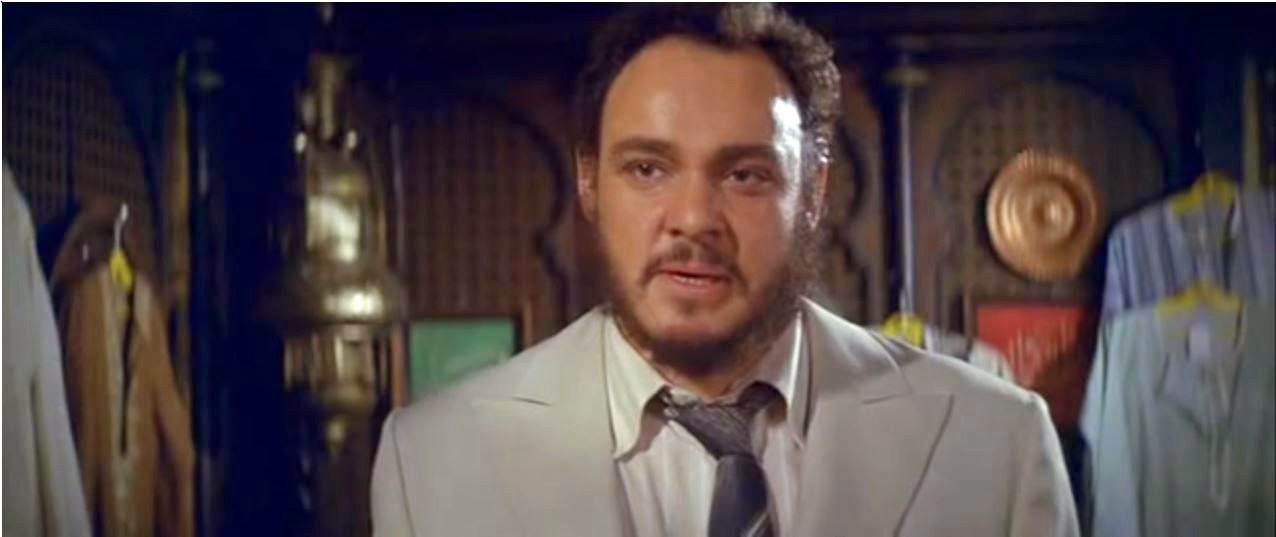
John Rhys-Davies as Stephanos Markoulis
He appeared as the less threatening Sallah in Raiders of the Lost Ark this same year

For poor Lesley-Anne Down, this means her character has to vacillate between being a resourceful, no-nonsense Egyptologist, a gushing tourist, and a screaming, hysterical ninny...sometimes all within the same scene. Saddled with a crayon-red hairdo that makes her look like the love child of Laurie Anderson and Annie Lennox, the movie asks us to take her character seriously while the filmmakers undermine her credibility by keeping every hair in place, clothes spiffy clean (that cream-colored jumpsuit must have been dipped in Scotch-Gard), and makeup flawless, no matter how many ruins she crawls around in.
Lady-Mullet and Shoulder Pads
A look as timeless as the Pyramids themselves

PERFORMANCES
I’ve liked Lesley-Anne down since I first laid eyes on her in A Little Night Music in 1977, and then a few months later in The Besty (another world-class stinker you should make it your business to see). She was so different in each film I scarcely knew it was the same woman. Although her subsequent output gave me pause (the deadly dull Hanover Street was almost the final nail), I was excited at the prospect of her being cast in Sphinx after reading the book and thinking it would, at last, provide the ill-used actress an opportunity to be something other than glamorous window-dressing.
The Stepford Egyptian
Talented actor Frank Langella (a lip-reader's nightmare, his mouth never moves when he speaks) must have used the saying, "Expressionless as a Sphinx," as his character motivation. Honestly, his performance is comprised of steely-eyed stares (his 1979 Dracula bit) while his voice emanates from...where... his ears?...certainly not that immobile, albeit kissable, mouth

Down is actually the best thing in the film, but on the whole that turns out not to be saying very much. At some point, the makers of Sphinx must have realized that they had constructed a thriller exclusively around a bunch of grim, glowering, middle-aged-to-elderly men (mostly silent) whose main interest is to keep a secret hidden. This may play well on the page, but it makes for a deadly dull movie. Subsequently, it falls to the Erica Baron character to shoulder the entirety of the film’s “thrill factor.”
So, as though to compensate for a whole lot of nothing coming from the male side of the cast, Down is directed to scream, shriek, jump, weep, yelp, and basically be in hysterics at annoyingly frequent intervals just to remind people they are watching a thriller. So while I can't say Lesley-Anne Down ever convinces me even for a minute that she's an Egyptologist, I have to hand it to her for giving the role everything she's got. For those who only know Down from the robotic demands of soap operas, the physicality of her performance in Sphinx should come as quite a nice surprise.
Scenery-10, Chemistry - 0

THE STUFF OF FANTASY
As a non-fan of the video game feel and look of movie CGI, Sphinx gets points simply for presenting such amazing, unenhanced vistas of Egypt. Shots of this breathtaking location are frequently accompanied by overly-majestic swells of music, but there is much to swoon over in the scenery, artifacts, and travelogue footage. Even if you hate the film and choose to watch it on fast-forward with the sound muted, I'd wholeheartedly recommend Sphinx for its outstanding travelogue visuals.

THE STUFF OF DREAMS
I don't really know if they make movies like Sphinx anymore (most likely they're on Lifetime if they do), but just watching it again recently made me very nostalgic for the days when one could count on at least one glossy, overproduced Hollywood trifle like this a year. It mattered not whether it came from the pen of Jacqueline Susann, Harold Robbins, or Sidney Sheldon, there was just the assurance that the result would be entertainingly escapist trash or a disaster of transplendent awfulness. It was a win-win situation.

Sphinx is too serious in approach and lacking in outrageously off-kilter casting to be a great camp classic (they would have had to cast Pia Zadora in the lead for that), but while it still hits all the necessary points for me to qualify it as an enjoyably "bad" movie, Sphinx has an appealingly old-fashioned feel to it that gets me where I live, nostalgically speaking. And by that I mean I occasionally appreciate movies that stumble and fall flat on their faces simply because they take me back to a time when movies actually looked like they were trying.


BONUS MATERIAL
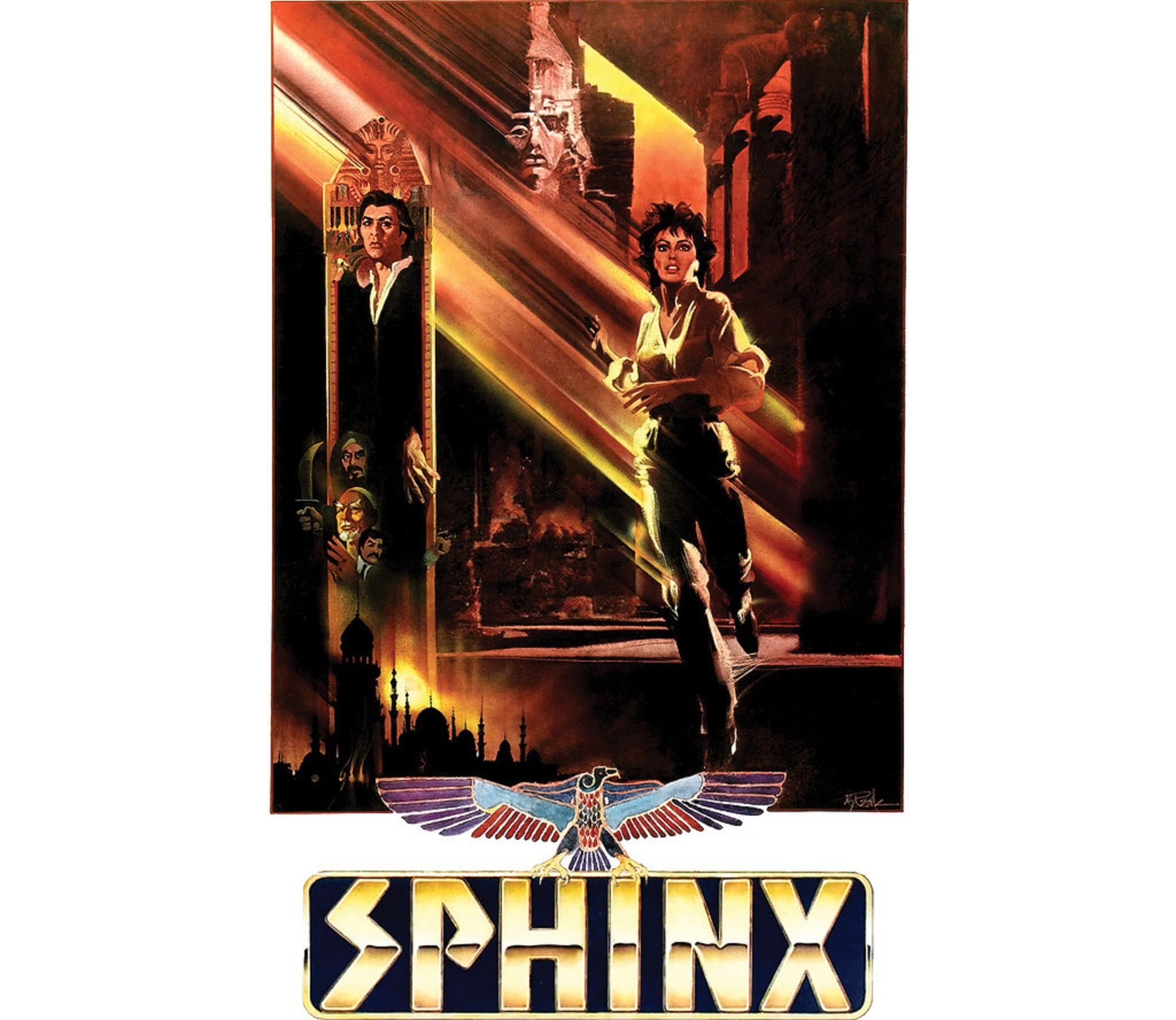
Poster artwork by Bob Peak


Copyright © Ken Anderson  2009 - 2014

Sunday, July 20, 2014

PICNIC 1955

Good, old-fashioned, classic movie storytelling doesn’t get much better than the first 80-minutes of Picnic. Comprehensive yet concise; expositional yet economical; intimate yet expansive, Picnic seamlessly blends sensitive drama, delicate humor, and dreamy romanticism. All the while sustaining an entertainingly effortless narrative flow.

Picnic’s depiction of life in a small Kansas town in the midst of prepping for Labor Day festivitiesits people, their routines and rituals, both mundane and apartis evocatively rendered in that uniquely idealized, true/false reality Hollywood does so well. Full of finely-observed details of character and setting redolent of William Inge’s childhood spent in Independence, Indiana (where his mother ran a boarding house inhabited by spinster schoolteachers), Picnic is set in the then-contemporary 1950s, but has thenceforth become cloaked in a rosy nostalgia which looks back on a time when drifters hopped boxcars, marriage was the end all and be all for any single woman, and people wore ties, sportcoats, and full-skirted dresses to picnics.
William Holden as Hal Carter
Kim Novak as Madge Owens
Rosalind Russell as Rosemary Sydney
Betty Field as Flo Owens
Susan Strasberg as Millie Owens
Cliff Robertson as Alan Benson
The last day of summer serves as both the time frame and primary narrative metaphor of Picnic, William Inge’s wistfully contemplative look at the sometimes painful inevitability of growing up. Following the death of his alcoholic father, handsome but feckless Hal Carter (Holden) drifts into town in search of a job from former college pal Alan Benson (Robertson), whose father is a grain industrialist. The story's unnamed Kansas town (represented in the film by four real-life Kansas towns) has a stressfully low male-to-female ratio, the heat and idleness of the summer contributing to the town's dormant powder keg atmosphere of sexual frustration and withering dreams.
Town beauty Madge Owens (Novak) is the vessel of everyone’s projected fantasies in spite of the fact that, while not very bright, she’s smart enough to know (in 1955 yet) that being the object of the appreciative gaze is not the same as being appreciated.

"Picnic," which I always assumed was a summer release, opened in Los Angeles on Tuesday, February 21, 1956. Oscar nominations were announced on February 18, and "Picnic" received six nominations, including Best Picture and Best Director. Though Hollywood buzz surrounded Rosalind Russell's performance, the film's only acting nomination went to Arthur O'Connell.

Into this ripe-for-disruption environment comes Hal, whose rambunctious, superannuated frat-boy actinvariably played out sans shirtunderstandably draws the attention of the local women folk. There’s favorable: the grandmotherly Mrs. Potts (Verna Felton); the puppy-love type: tomboy-in-transition, Millie Owens (Strasberg); distrustful: Flo Owens (Field), a mother alone raising two girls; conflicted: repressed schoolmarm Miss Sydney (Russell); and of course, love at first sight: Madge. Hal’s appearance in town has a different effect on each character, and as they all converge at the picnic, Labor Day becomes something of a day of reckoning, bringing out the best or worst in each individual. Truths are confronted, illusions shattered, facades dropped, and everyone's eyes are opened, and everyone is forced to grow up just a little bit. 
Verna Felton as Helen Potts
TV fans will recognize Felton from her guest stint as the maid from hell on I Love Lucy, or as the voice of Wilma's mother on The Flintstones

Picnic is one of those movies I discovered on TV as a child (loaded with commercials and only in an awful pan-and-scan version) and fell in love with from the start. To this day, Picnic remains one of my favorite comfort movies. I can watch it (the first third, anyway) anytime, anywhere. These days, without exception, if ever I happen to be channel-surfing cable TV and Picnic pops up, I always tell myself I’m only going to watch it for a couple of minutes, but before I know it…boom! an hour has passed. That I own a DVD copy of it matters not a whit…I just take such pleasure in the film's setting, characters, conflict, and dialogue; I never tire of it.

That I expressly favor the first 80-minutes of this nearly two-hour film (those comprising the introduction of the main characters, establishment of the central plot, and the picnic scene in its entirety) speaks to director Joshua Logan’s breezy and sure-footed handling of these character-driven, slice-of-life early sequences. Winner of the 1953 Tony Award for his direction of the original Broadway production, Logan shines brightest when Picnic captures vivid tableaux of small-town culture or compassionately conveys the defeated spirit born of withered dreams and repressed hope.
As fellow schoolteachers, character actresses Reta Shaw (Irma Kronkie) and Elizabeth Wilson (Christine Shoenwalder) recreate roles they originated on Broadway

Somewhat less persuasive is his handling of the film’s final third, which becomes a little too melodramatic and plot-driven for my taste. Here, as if under outside pressure to provide some “action” in an otherwise gentle romantic drama, Inge’s sensitive play feels as though it were temporarily hijacked by Douglas Sirk. And to little effect, I'm afraid, as the swift introduction of a gratuitous car chase and an unconvincingly staged two-against-one fistfight with armed lawmen merely succeed in being distracting. Not helping matters further is the fact that, in lieu of a then-unthinkable sex scene between Holden and Novak, we have in its place three (count ‘em, three) repetitious and very talky “tortured longing” scenes between Holden and Novak that never fail to leave me looking at my watch.
Discounting this sluggish detour, Picnic gets back on track with the final scene, where story threads are tied up, and Rosalind Russell’s performance single-handedly reinforces my opinion that the too-casual romance between Rosemary and Howard is the film’s most satisfying love story. 
Oscar-nominee Arthur O'Connell recreating the role he originated on Broadway.
Many thought Rosalind Russell was a shoo-in for a nomination, if not a win, had she allowed herself to be submitted in the Supporting Actress category, which she refused. 

WHAT I LOVE ABOUT THIS FILM
Even as a kid I was hard-pressed to imagine a time when a film as tame as Picnic could ever be considered racy.  But of course, at that age I had no idea that Madge and Hal’s impassioned embraces alongside that barreling freight train was Censorship Code shorthand for sex, and, to be honest, only after it was brought to my attention in a college film class did it ever cross my mind that it was Inge’s intention to intimate (a little too subtly, if you ask me) that Rosemary and Howard had also had sexual relations that night. Who knew?  Anyway, from its male bodice-ripper ad campaign to its convention-flouting themes of sexual frustration and libidinous urges, Picnic was pretty hot stuff in its day.
But Picnic’s reputation as a classic romantic movie doesn’t resonate with me very strongly (the sex feels born of despondency more than passion). Not as strongly as its sharp-eyed, often witty, depiction of small-town life and the incisive details William Inge (Splendor in the Grass, Come Back, Little Sheba) brings to his characters.
Failure to Live up to Expectations
Alan's resentment of Hal is rooted in feeling he is a disappointment to his father
Inability to Accept Reality
Flo copes with past failures by projecting all of her hopes for happiness on her daughter, Madge 
Lack of Identity
Madge longs to find something to value about herself beyond her beauty 

PERFORMANCES
Picnic is a uniformly well-acted motion picture that, like a great many '50s films adapted from stage plays of the day (the works of Tennessee Williams come to mind), retains a certain staginess in dialogue and acting style which locks it forever in a particular era. The overall appealing performances in Picnic also seem a tad old-fashioned, playing favorably into the glimpse-into-the-past, days-gone-by feel of the movie. 
Madge is crowned Neewollah Queen

Perhaps because the central romance feels as though it's based primarily on physical attraction (for all his talking, Hal never asks Madge anything about herself), my strongest memories of Picnic have to do with Rosalind Russell’s superb performance as Rosemary, the old-maid schoolteacher. In a career of many high points, I think this is one of Russell's best performances, and she practically walks off with the entire film. (Which is probably what Russell felt, too, explaining her refusal to be considered as a supporting player by the Academy.)
Here, the actress's trademark sardonic wit and vitality are channeled into a character whose thin veneer of nonchalance and dimming vestiges of pride show the wear of too many lonely Labor Days bleeding into solitary school semesters. Russell gives the role everything she's got, and she is, in every scene, a force of nature daring you to look at anyone else. She’s funny, moving, sad, and even pitiful; but you wind up rooting for her, and she’s a marvelously sympathetic, dimensional character. 
If Picnic falls short of being the great film it might have been, I'd attribute it to the sense I have that everybody is pushed a little too strongly against type. I agree with the common complaint that William Holden is too old for his role (not jarringly so, but his college days seem far, far behind him) and that his attempts at expressing Hal's coarse nature aren't all that convincing. And while he's every inch the likable charmer the role requires, Holden's efforts just feel forced when trying to play dumb. The same can be said for the sad-eyed Novak, who has Madge's vulnerability down but lacks (oddly enough) the kind of switchblade protective shield of vanity that unconfident pretty girls carry around like security blankets. She too, seems a bit too astute.

Susan Strasberg, while the right age for Millie, is far too angularly beautiful to be believable as either a tomboy or anybody's definition of "goonface." She seems out of her element in the earlier scenes where she's called upon to convey juvenile anxiety, but she relaxes into both herself and the role as the film progresses. Cliff Robertson, on the other hand, is a perfect fit. I've never been much of a fan of Robertson, but I like him a great deal in this movie.
"I had a job as a model once...like this. They had me posing in front of a class almost raw."
Hal shares one of the high points of his checkered past with the adoring Millie. For those too young to know just what '50s male physique modeling looked like, I offer this real-life sample to illustrate that Mr. Holden was right on the money. The nude model is Tabby Anderson (!) which is the ideal name for my cat...if I ever get one.

THE STUFF OF FANTASY
When I was a child, it seemed every household in the neighborhood had an LP of the Picnic soundtrack, or, if not the score itself, most certainly one of the myriad easy-listening versions of “Moonglow/ Theme from Picnic” available on instrumental collections from the likes of Living Strings or Ferrante & Teicher. I cannot honestly recall when I first heard this popular medley (which I considered “old people’s music” at the time), but it’s as much a part of my childhood as the theme from The Mickey Mouse Club, and to this day I can’t hear Moonglow (a 1933 song, I was later surprised to discover) without seeing William Holden and Kim Novak dancing so photogenically under those paper lanterns.
In this great shot representative of the consistency in performances throughout Picnic, each character reacts differently to the sight of Madge as she's crowned "Queen of Neewollah" 

Well, perhaps calling Novak & Holden's movements “dancing” is casting a rather wide net (neither star held any illusions about their dancing skills, Holden being so reluctant as to request extra pay and getting himself fairly drunk before filming), but after all these years I still get quite a kick out of that iconic sequence. Both actors radiate old-fashioned movie star luster; Novak’s steady, unbroken gaze is sexy as hell, and that elusive thing called chemistry is present in almost corporeal abundance.

Composer George Duning’s Oscar-nominated score--which, upon occasion, veers perilously close to Carol Burnett-spoof territory when significant dramatic events are histrionically emphasized by blasts of horns serving as the musical equivalent of exclamation points--is absolute perfection here. The smooth jazz arrangement of the pop standard Moonglow, lushly underscored by the orchestral Picnic theme, creates a sense that our lovers-to-be are dancing to two songs: the tune played at the picnic itself, and a melody only they alone can hear.

THE STUFF OF DREAMS
William Inge’s Picnic won the Pulitzer Prize for Drama in 1953, but if your only familiarity with it is the film version--rather brilliantly adapted and opened-up for the screen by Academy Award-winning screenwriter Daniel Taradash (From Here to Eternity) --seeing it on stage can be quite the sobering experience. In the theatrical version, all the action plays out on the back porches and adjoining backyards of Mrs. Potts and Mrs. Owens. The titular picnic is never shown!

Happily for literal-minded me, the film version has a masterfully constructed, protracted picnic sequence that not only shines as a fine example of studio-era location shooting, but serves as the film's narrative and thematic nucleus. The five-minute montage that kicks off the sequence is so good it could stand alone as a short film highlighting 1950s Americana. James Wong Howe's CinemaScope cinematography covers all the action and bathes everything in a honey-colored glow; no wonder this amusing and appealing sequence remains the part of Picnic I remember most fondly.
Save for the obvious set for the Moonglow dancing dock, the entire picnic sequence was filmed in Halstead, Kansas. The swimming lake scenes in Sterling, Kansas. In the screencap above, that's Nick Adams (Bomber) and What's My Line? stalwart  Phyllis Newman (Jaunita Badger).

Clip from "Picnic" (1955)


BONUS MATERIALS 
Jennifer Jason Leigh played Madge in a 1986 made-for-cable-TV production of Picnic for Broadway on Showtime co-starring Gregory Harrison (who produced, answering any "WTF?!?" casting questions) and Rue McClanahan. Like the 1987 film Dirty Dancing, this adaptation of Picnic, although set in the 1950s, has 1980s written all over it. It's available for viewing on YouTube.

I didn’t grow up in a small town, and this typically Hollywood, all-white vision of Midwestern life is nothing I clutch to my bosom with misty-eyed nostalgia (although with HD and sharp eyes you might catch a fleeting glimpse of one or two Black people in the picnic scenes). But on a human level, I tend to find irresistible any story which celebrates, with compassion and dignity, the small struggles and victories of people leading simple lives. Few writers conveyed this with as much heart and humor as William Inge.

Copyright © Ken Anderson   2009 - 2014