Showing posts with label John Huston. Show all posts

Saturday, May 1, 2021

CHINATOWN 1974

"Mrs. Mulwray, I think you're hiding something."

Whether for the prestige, visual opulence, short-hand history, or easy-access sentimentality, period films and costume dramas have always been a Hollywood staple and a vital part of movie storytelling. But in the 1970s, the need for some kind of collective breather from the relentless tensions of the “Now” (i.e., Vietnam War, Watergate, impeachment, oil crisis, inflation) produced a market-surge interest in movies set in the “Then.” Particularly the then of the 1920s and 1930s.
Some of these films were escapist homages to retro genres (At Long Last Love -1975). Some were style-fetish showcases devoted to the detailed reconstruction of the fashions, furnishings, and décor of the era (The Great Gatsby -1974). And some were trenchant exercises in ‘70s disillusionment whose nihilist themes were tempered by the distancing device of taking place in America's recent past (The Day of the Locust -1975). Roman Polanski’s Chinatown managed to be all three.
Jack Nicholson as Jake Gittes

Faye Dunaway as Evelyn Cross Mulwray

John Huston as Noah Cross

The collaborative effort of the members of the “New Hollywood” Boys Club: producer Robert Evans (The Godfather, Marathon Man), screenwriter Robert Towne (Shampoo, The Last Detail), and director Roman Polanski (Rosemary’s Baby, Macbeth), Chinatown had a bumpy, three-year journey to the screen (covered in deliciously intricate detail in Sam Wesson’s book The Big Goodbye: Chinatown and the Last years of Hollywood). But when Chinatown premiered in theaters in the summer of 1974, the many arguments, rewrites, firings, walkouts, and endless weeks of tinkering proved not only to be more than worth the effort, but stood as evidence of the degree of care and artistry that went into fashioning a film that many today regard as a modern masterpiece of American cinema. 
Love the composition of this shot. Even the body language of the characters is perfect

Hardly considered the sure-fire success its current reputation would suggest, Chinatown struggled through disastrous previews and a difficulty generating pre-release interest in a 1974 movie marketplace dominated by the twin publicity blitzkriegs of Lucille Ball's ill-conceived Mame and Robert Redford's The Great Gatsby. Three-time Oscar nominee Jack Nicholson (his most recent being a Best Actor nod for 1973's The Last Detail) was hot at the time, but there existed considerable doubt among many as to how he would come across in this, his first stab at a leading man glamour role. 
Meanwhile, Faye Dunaway's post-Bonnie and Clyde screen output had proved erratic at best, with her The Thomas Crown Affair (1968) golden girl patina coming perilously close to tarnishing after a string of arty flops and effective but unfruitful supporting roles. Then there was Roman Polanski...with his days as New Hollywood's European wunderkind a matter of history and coming fresh off two back-to-back boxoffice bombs (Macbeth -1971 and What? -1972), his name carried about it an aura of fall-from-grace tragedy (the Manson murders) in a town ruled by superstition.
Darrell Zwerling as Hollis Mulwray

Further contributing to the uncertainty surrounding the film's reception was the fact that a quick recounting of Chinatown's plot-- "A private eye in 1937 Los Angeles investigates a mystery involving a real estate swindle and the city's water rights!" --didn't exactly set the pulse racing. 
But what Chinatown had going for it was that it was an original. Not an adaptation of a previously-produced novel, film, or theatrical production. As '70s movies became more formulaically bloated (The Way We Were -1973) and market-driven slick (The Sting - 1973), Chinatown's creative integrity vs its dubious box-office prospects felt like a throwback to Hollywood's very recent past. Back to the start of the decade when difficult-to-categorize films like Diary of a Mad Housewife (1970) and Five Easy Pieces (1970) were being made because they were stories the filmmakers wanted to tell, not because they were sure-fire blockbuster material.

The first time I saw Chinatown, it had me in its hip pocket the minute those stylish opening titles appeared to the accompaniment of Jerry Goldsmith's mysteriously forlorn theme music. And though the film had an alluringly old-fashioned sound and succeeded in creating a vision of a past that felt lived-in, not decorative, Chinatown somehow managed to sidestep things that might have made it feel imitative or as paying affectionate homage to another movie…Chinatown looked and felt like the genuine article.

It didn't seem quite possible that Polanski and Co. had managed to make a film that worked magnificently as a mystery (the particulars of the twisty plot--murder, political swindling, family secrets ---are not exactly easy-to-follow on first viewing); achieved a kind of visual poetry (the movie looks swelteringly hot! How did they do that?), and was propelled by the emotional connection of compelling characters whose fates you came to care about (the performances are uniformly first-rate...right across the board). 
Chinatown, in both style and execution, is a jet-black neo-noir that realizes--with a persuasive canniness I still can't quite put my finger on--both Robert Towne's goal of writing a story in the tradition of Raymond Chandler Dashiell Hammett, and Roman Polanski's desire to create: “A film about the ‘30s seen through the camera eye of the ‘70s.” 
Chinatown gets everything right. In creating the slightly artificial authenticity of Los Angeles in the '30s, Polanski nailed it when he observed "People know this time because of the movies, not because of what was real."

Given a contemporary sheen thanks to its widescreen Panavision color photography that "feels" like B&W, Chinatown evokes the classic detective movies of the past via its keen eye for period detail and avoidance of so many of the nostalgia-craze movie gimmicks of the time: no diffused lighting, no voiceover narration, no self-conscious “period” jargon, and no knowing winks to the audience. And here's a bonus...the actors actually look comfortable and convincing in their period clothes! (For the alternative, aka, kids playing dress-up, see Baz Luhrmann's The Great Gatsby - 2013 or  Mank - 2020). 
The result is a movie that's as satisfying as a genre entertainment as it is a dark and existentially layered contemplation on corruption, the destruction of innocence, and, as per Towne, "The futility of good intentions."
Chinatown provides many memorable "goosebump moments," this scene being one of my favorites. I absolutely love Dunaway's delivery and the struck look in Nicholson's eyes when Evelyn asks about the mystery woman in Jake's past. As we'll discover, Evelyn & Jake are two people united by the things they're trying to forget.


THE STUFF OF FANTASY
One of the main reasons Chinatown made such an impression on me is that it was the very first noirish private eye movie I ever saw. 
In 1971 LIFE magazine devoted its February cover to America’s burgeoning nostalgia craze, and by 1974, everything from fashion to music reflected the nation’s fascination with life enjoyed in the rear-view. The summer of 1974 saw San Francisco movie theaters so overflowing with retro fare, it took considerable effort to find a film set in the present day: Chinatown, The Great Gatsby, The Lords of Flatbush, That’s Entertainment!, Mame, The Three Musketeers, Daisy Miller, Thomasine and Bushrod, Blazing Saddles, Jeremiah Johnson, Huckleberry Finn (of all things), and Our Time (a little-seen coming-of-age movie set in the ‘50s that opened at the Alhambra during the summer I worked there as an usher). 
The Two Mrs. Mulwrays
Diane Ladd as Ida Sessions. There is a subtle wit to Ladd's performance as the prostitute/movie bit player hired to impersonate Evelyn Mulwray. Miss Session's attempt to affect an air of moneyed aristocracy hints at her lack of success as an actress.

When Chinatown came out I was a 16-year-old movie buff with a passion for contemporary films almost to the exclusion of all else. Back then, my appreciation for classic movies was largely academic and aesthetic (i.e., I enjoyed reading about them and decorated the walls of my bedroom with posters of Marilyn Monroe, Glark Gable, and WC Fields), not practical. Which meant I hadn’t yet seen The Big Sleep, The Maltese Falcon, or any of those classics on The Late Show about hard-boiled detectives and dangerous women. At sixteen I was much too in thrall of the then taboo-shattering adult themes and newfound unrestricted nudity, sex, & violence of ‘70s films to ever find the Production Code coyness of old movies to be of much interest. That is, except for musicals. Ken Russell’s The Boy Friend (1971) ignited my love for old MGM musicals and the films of Busby Berekely, but that’s pretty much where my interest in “Golden Age" Hollywood films began and ended. 

The latter point, my love of musicals, goes to plain why, when That’s Entertainment! and Chinatown both opened on the same day in San Francisco (Wednesday, June 26th), I opted for That’s Entertainment!. An option I exercised for two more weekends before getting around to seeing Chinatown.
Roman Polanski as Man with Knife

WHAT I LOVE ABOUT THIS FILM
Maybe it’s the Blu-ray talking, but I’m obsessed with what a fabulous-looking movie Chinatown is. The Oscar-nominated team of cinematographer John A. Alonzo, production designer Richard Sylbert, and art director W. Stewart Campbell give Chinatown an atmospheric sheen that is often breathtaking in its evocation of sun-baked Los Angles in the late ‘30s. 
But despite the obvious care and expense lavished on every frame, Chinatown's distinction is that it is a period film that has no interest in romanticizing the past. With traditionally swept-under-the-nostalgia-carpet realities like racism and classist privilege flowing like an undercurrent in a narrative propelled by graft, collusion, murder, and incest; Chinatown’s surface sheen creates a dichotomy that challenges the dreamy ideals one associates with old movies. Cynicism has always been a part of the detective movie genre, but no matter how nihilist the theme, by fade-out, the requisite virtues of honor, heroism, and the triumph of good had to be reinstalled. Chinatown, however, ends with a punch to the gut and the ground knocked out from under us.
Me in 1974:  "Wow, even in so-called simpler times, rich people were greedy and corrupt!"
Me in 2021: "Wow, this movie is almost 50 years old and the rich are still as corrupt and greedy as ever!"

PERFORMANCES
Robert Towne wrote the character of J. J. Gittes with pal Jack Nicholson in mind, so the star-making role of the principled private eye with a taste for Florsheim shoes and words like “métier” fits the actor as perfectly as one of Jake’s tailored suits. This is my favorite of all Nicholson’s performances and arguably his last real immersion in character before entering the “Wink-wink, it’s me! Jack Nicholson!” phase of his career. The entire film is from his perspective...Chinatown is Jake’s journey. But its mystery, tragedy, and heart (and my favorite character) is Evelyn Mulwray.
Jane Fonda in Julia (1977) - Even Robert Towne had Fonda in mind when he wrote Chinatown

Both Robert Evans and Roman Polanski have made it known that Jane Fonda was their 1st, 2nd, and 3rd choice for the role of Evelyn Mulwray. But when Fonda declined (something the actress denies), Chinatown gained Faye Dunaway…the jewel in Chinatown’s crown and the only ‘70s actress in my eyes to possess the combined intensity, inscrutability, aristocratic bearing, neurotic edge, old-fashioned movie star glamour, and grown-woman gravitas required to bring Evelyn Mulwray to life as something more than just another vaguely-drawn film noir femme fatale cliché. 
As Chinatown’s woman of mystery (she who must not be known until Act III), Evelyn Mulwrays’s impact has to be visual. A guarded woman who’s erected an immaculate façade to conceal just how badly she’s damaged, Evelyn intrigues because she is not at all what she seems. So defining a character trait is Evelyn’s appearance that when the film starts to peel away the layers of Evelyn’s very literal “mask” of makeup as her vulnerability is exposed, those moments achieve a poignancy that makes the film's tragic denouement all the more devastating. Faye Dunaway captures all this magnificently, but is seldom given credit.
Journalists applauded Polanski's time-consuming multiple takes and Towne's glacially slow writing pace as examples of their artistic perfectionism. Meanwhile, Dunaway's painstaking commitment to her character's obsession with appearance was dismissed as prima donna "difficulty" and made her behind-the-scenes clashes the only things people talk about when speaking of her contribution to Chinatown. Despite his early reservations, in the end, Robert Evans came to praise Dunaway's performance to the skies, albeit in his usual self-congratulatory way: "Dunaway's singular mystery on the screen was among the best casting choices of my career!"


THE STUFF OF DREAMS
There are a great many '70s films that I love in spite of (or because of) their flaws. But only a few I'd call perfect. Robert Altman's 3 Women (1977) gets my vote for being a wholly perfect film, so does Ken Russell's Women in Love (actually a 1969 film, but I'm cutting myself some slack because it wasn't released in SF until 1970), and most definitely, Chinatown qualifies. 
And by perfect, I don't mean an absence of technical goofs or anachronism errors... it's more the feeling of everything fitting so well together that you can't imagine anything being improved upon. The feeling that a story has been told in precisely the manner the filmmakers wanted to tell it. In the case of Chinatown, everything falls into place so ideally, from the cast, to the music, to the dialogue, to the score...watching it becomes an immersive, deeply satisfying experience that engages on so many levels. I never tire of revisiting it, and the film seems boundless in offering new things to discover even after all this time. But best of all, it still manages to move me. 
I'm no longer as totally destroyed by it as I was when I was 16, but at age 63, this masterwork of cinema persists in giving me waterworks every single time.   

Thankfully, films are frozen in time. People, alas, are not. In 1974, audiences drew subconscious parallels between the dogged tragedies of Roman Polanski's personal life and the cursed fate of J.J. Gittes. Today, I'm afraid the parallels linking Polanski and Noah Cross fairly hit one over the head.


Clip from "Chinatown" (1974)


BONUS MATERIAL
Actor Paul Jenkins, who plays Policeman #1 in Chinatown (1974), made his film debut as a policeman in Polanski's Rosemary's Baby (1968).


Chinatown was planned as the first film in a trilogy. A plan that ground to a halt after the weak boxoffice performance of the second entry, The Two Jakes (1990). Set in 1948, the Jack Nicholson-directed sequel sorely misses Polanski's gift for cinematic storytelling and gets my vote for film most likely to convince you that Chinatown didn't need a sequel in the first place. Still, I did get a kick out of seeing these actors from the original return. 

Poster art by Jim Pearsall 
Chinatown was a summer release, opening on Wednesday, June 26, 1974, at San Francisco's Coronet Theater (which had just hosted The Great Gatsby for 11 weeks). I fell in love with the movie poster the instant I saw it, purchasing it a full month before seeing the film. The artwork captures just the right tone of nostalgia, the shadowy figure of the hatted and pinstriped Nicholson leaving no doubt as to the film's noirish roots, the dreamy image of Dunaway's face framed by the trails of cigarette smoke. the essence of romantic longing. 
The water motif is worked in with the wave crashing against Nicholson's sleeve, it being one of several elements of the poster that refuse to stay within the boundaries of the frame. From the lettering to the heat-glare effect of the coloring, everything about this poster is just perfect.  


Copyright © Ken Anderson  2009 - 2021

Tuesday, May 7, 2013

MYRA BRECKINRIDGE 1970

Although Myra Breckinridge was a movie that thoroughly captured my adolescent imagination and attention in 1970, it was also one of the few films my parents absolutely forbade me to see. My folks were usually obligingly (and conveniently) in the dark about the many age-inappropriate matinees I traipsed off to on Saturday afternoons, but Myra Breckinridge proved an inopportune exception. Behind it all was the fact that my parents owned a hardback copy of Gore Vidal's satirical novel (which my sisters and I snuck clandestine, barely-comprehending, peeks at). Thus, they weren't about to let their Catholic School-attending, 12-year-old son see a movie whose much-touted set-piece and raison d’être was the strap-on rape of a young man by a transgender woman in a star-spangled bikini. Good parenting will out!

Needless to say, all of this failed to quell my fascination with the film. On the contrary, it fueled it. The hype surrounding Myra Breckinridge (the words"disgusting" and "obscene" almost always in attendance) set my hormonal teenage mind racing at the thought of Hollywood making the first big-budget, all-star, dirty movie. And here I was, a young man fancying himself a mature-beyond-his-years cineaste, present at what looked to be a seminal moment in the cultural shift in American motion pictures...and I wasn't allowed to participate in it. Life can be so unfair.
"It's going to be treated importantly. It's not going to be dismissed."
A sweetly delusional Welch speaking about Myra Breckinridge on The Dick Cavett Show

Well, as we all know, once Myra Breckinridge hit the theaters, that anticipated cultural shift turned out instead to be but a brief detour into a blind alley. Myra Breckinridge tanked stupendously at the boxoffice, taking with it, Mae West's unasked-for comeback, Raquel Welch's already tenuous legitimacy, and director Michael Sarne's entire career (every cloud has a silver lining). Following months and months of pre-release hoopla, Myra Breckinridge swiftly dropped out of sight, and by the time I finally got around to seeing it, I was 21 years old. It was showing on a double bill with Beyond the Valley of the Dolls at the Tiffany Theater in Los Angeles (a Sunset Strip revival house just blocks away from the site of that iconic rotating cowgirl billboard).
The Sahara Hotel billboard on Sunset Blvd with the iconic rotating showgirl atop a silver dollar.
 The billboard was erected (if I can use that word in a Myra Breckinridge post) in 1957 and, at one time, included a pool and bathing beauties. It remained in that spot until 1966. 

The billboard became a landmark, showing up in films like William Castle's The Night Walker - 1964 (bottom) and the Joanne Woodward movie The Stripper - 1963 (top) as a kind of visual shorthand for Hollywood's artifice and merchandising of sex.

The billboard was recreated for the film. Myra, the symbol of the new woman.

Obscene and disgusting are certainly in the eye of the beholder, but it's my guess that this sexual revolution comedy was a good deal more shocking at the start of the sexual revolution than during its last gasps. I saw Myra Breckinridge in 1978, and by then, the New Hollywood was on the verge of obsolescence, the underground films of John Waters and Andy Warhol had practically gone mainstream, disco was on the wane, Linda Lovelace had found religion, and The Rocky Horror Picture Show was the latest word in gender-bending camp. In this atmosphere, Myra Breckinridge's legendary irreverence seemed almost quaint. With nothing to be shocked about in its content, all that was left to respond to was the freakshow spectacle of movie stars--who should have known better---making absolute fools of themselves. This may not sound like much, but in the days before reality television, celebrities humiliating themselves was a rarity, not a nightly prime-time attraction.

If you don’t count a thoroughly delightful episode of Mr. Ed (!) in 1965, Myra Breckinridge was Mae West’s first time in front of the cameras since 1943’s The Heat’s On. Top-billed and paid more than twice Raquel Welch's salary, West insisted on singing several songs in the film, although it really made no logical sense for her character, who was a talent agent, of all things. But nobody went to Myra Breckinridge looking for sense.
Observant fans recognize Mae's nightclub as the surgical arena where Myron's operation is performed at the film's opening. Whether this was a budgetary compromise or an early, intentional indication that the movie we're watching is playing out as a hospital fever dream cooked up in Myron's head scarcely matters. Since the movie as a whole makes almost no sense.

Much like when a little kid learns his first words of profanity and proudly struts about shouting "Fuck...fuck...fuck...," with no comprehension of what he is really saying; Myra Breckinridge's so-called sexual effrontery is peculiarly naive, and thus, uproariously funny...but in almost none of the ways intended.
Behind Myra Breckinridge's convoluted fantasy about a gay movie buff (a typecast Rex Reed) transitioning to become the Amazonian Myra Breckinridge (Welch) in order to destroy masculinity and thus realign the sexes (!?!), there lurks a rather cynical and misanthropic film devoid of subversive convictions, sexual or otherwise, beyond doing anything it can to attract a young audience. At this time, 20th Century Fox was so keenly feeling the sting of mega-flops Star!, Doctor Dolittle, and Hello Dolly!, they would have released a widescreen epic about aluminum siding installation techniques if they thought it would be a hit.
Myra Breckinridge is beautifully shot, and splendidly costumed, and I really thought the use of old movie clips was quite inspired; but the casting, script, and performances are downright surreal. I couldn't wrap my mind around this being a film that a major studio actually thought audiences would turn out to see. Even by the screwy standards of '70s gonzo cinema (see: Angel, Angel Down We Go), Myra Breckinridge is bizarre beyond belief.
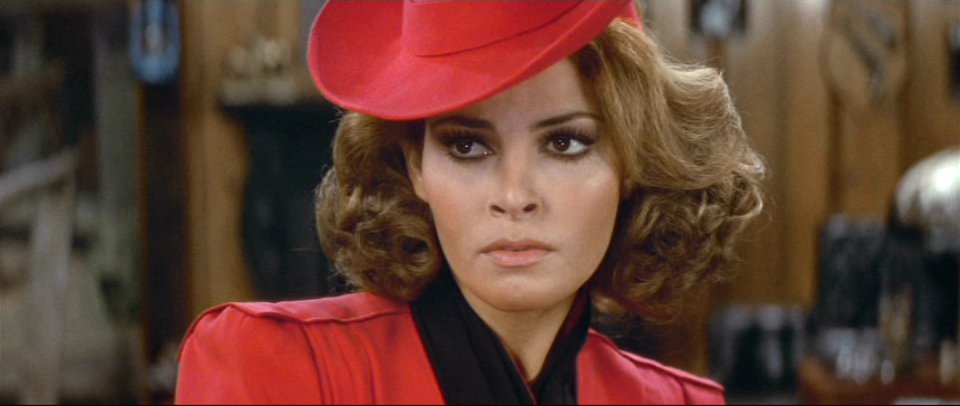
Raquel Welch as Myra Breckinridge
Mae West as Leticia Van Allen
John Huston as Buck Loner
Roger Herren as Rusty Godowski
Farrah Fawcett as Mary Ann Pringle
Introducing Rex Reed as Myron Breckinridge
Although Myra Breckinridge ranks rather high on my roster of favorite cult films, I've put off writing about it until now because, unlike flawed films which actually work for me on some level (like Xanadu or Valley of the Dolls)Myra Breckinridge is a rarity in that it is one of the few films I take pleasure in precisely because it doesn't really work at all. I know that sounds odd, but Myra Breckinridge is such a misguided oddityfrom concept to execution—that it commands a kind of respect. You marvel at how anyone involved in getting it to the screen ever thought there was any hope for the film at all. It's not a film I laugh with (outside of John Huston's note-perfect performance, this is one of the least funny comedies I've ever seen); it's a film I gleefully laugh at.

I'm reminded of the 1955 Frank Tashlin comedy, The Girl Can't Help It, a movie that appears on the surface to be a celebration of rock & roll but is actually a scathingly satiric, anti-rock & roll diatribe. Myra Breckinridge sets itself up as a contemporary sex comedy out to skewer America's sexual hypocrisy and lampoon Hollywood's repressed gender images; but at its core, it's a staunchly anti-sex film, borderline homophobic, and deeply embarrassed by itself. A sexual fake-out promising a more progressive experience than it's capable of delivering.
Something is definitely wrong with an X-rated film that puts Raquel Welch and Farrah Fawcett together in the same bed and doesn't know what to do with them.

Starting with the bait-and-switch casting of Ms.Welch herself (what else but a perverse sadistic streak would inspire the casting of '60s sex symbol Raquel Welch in an X-rated movie, only to have her be one of the most overdressed members of the cast?), the people behind Myra Breckinridge not only appear to have had little to no understanding of the book, but seem to have harbored an outright contempt both for its subject matter and the young audience whose favor it hoped to curry. Every frame has the feel of 20th Century Fox communicating its resentful vexation at having to stoop so low in order to appeal to the base sensibilities of the suddenly indispensable youth market that kept American movie box offices in a stranglehold during the '60s and '70s.
It's not for lack of bread, like The Grateful Dead
Michael Sarne (l.) played a director on the set of Myra Breckinridge. Donald Sutherland (r.) who had a small role in Sarne's first film, Joanna, played a Michael Sarne-esque director in 1970s Alex in Wonderland
Listen to Michael Sarne's 1964 pop hit, "Come Outside" HERE  

Alfred Hitchcock and Cecil B. DeMille may have worn a suit and tie while directing, but by 1970, long hair and a beard were considered standard equipment if you wanted to be taken seriously in Hollywood. Michael Sarne was a former British pop star with only one other film to his credit (Joanna, a film I actually liked) before being handed the $5 million reins to a movie at one time pitched to talents as diverse as Bud Yorkin (Start the Revolution Without Me) and George Cukor. Michael Sarne has continued to work as an actor, appearing in a small role in 2012's Les Misérables, but the debacle of Myra Breckinridge effectively ended his career as a director of any note.
In spite of  (or perhaps because of) the high-profile nature of his role in Myra Breckinridge, actor Roger Herren virtually disappeared from film and television work within ten years of the film's release. He passed away in 2014 at the age of 68.

WHAT I LOVE ABOUT THIS FILM
The only people I know disappointed in seeing Myra Breckinridge for the first time are those expecting it to live up to its notorious reputation. Always a very tame “X”, Myra Breckinridge is nowhere near as explicit as its rating would suggest, ideologically dated, more asexual than sexy, narratively jumbled, not particularly funny, and arrives at its cult appeal mostly by way of having its laid-on-with-a-trowel attempts at intentional camp land with a resounding thud.
Calvin Lockhart, the handsome star of Michael Sarne's Joanna, portrays the flamingly effeminate Irving Amedeus, a perennial acting student at Buck Loner's Academy. In a film with so many people to offend in a mere 94 minutes, Lockhart's overbroad caricature saves time by being simultaneously offensive to both Blacks and gays.

So what does work about the film? To enjoy Myra Breckinridge, one has to accept that its greatest value is as sociological artifact. In the staunchly conventional world of moviemaking, Myra Breckinridge is an oddity that could not have been made at any other time in the history of motion pictures...not even today. Its weirdness is almost exhilarating. You may not get it, hell, you may not even enjoy it that much, but to watch this film is to gaze into the very heart of the panic, chaos, and desperation that was Hollywood in the transitional sixties and seventies. With cinema icons John Huston and Mae West relegated to the roles of dirty-old-man / dirty-old-woman, sexpot Raquel Welch used as the uncomprehending butt of the film’s sole sex joke, and a glossy, $5 million production built around pissing on the entirety of motion picture history, Myra Breckinridge is a big monster truck rally face-off between Old Hollywood and New Hollywood.
In a role originally intended for Mickey Rooney (I shudder at the thought) John Huston gets into the absurdist spirit of things and is terrific. Mae West (here looking more than a little like Nancy Sinatra) is, unfortunately, more crass than sass when her legendary talent for comic innuendo is replaced by blunt coarseness.

PERFORMANCES
No actor gets to choose the role for which they will always be associated and remembered. Sometimes, as in the case of Mia Farrow and Rosemary’s Baby, it occurs at the start of a career and establishes a difficult-to-live-up-to standard. When the fates are not kind, it can happen mid-career with the taking on of an embarrassing role that unjustly overshadows all the quality work that came before (think Faye Dunaway and Mommie Dearest). Raquel Welch, a breathtakingly beautiful actress whose career...if one were to base such speculations on talent alone...could well have gone the way of Edy Williams, has in Myra Breckinridgefor better or worseone of the best roles of her career. Certainly, it's a role that offered something of a challenge for the actress after a long string of "decorative starlet" leads and walk-ons. 
Myra: A Simple Girl With a Dream
I can't imagine a major actress taking on this role today. Had the film been successful, what kind of "better" parts did Ms. Welch hope would come her way? As for the vulnerable Mr. Herren, he wisely dropped off the face of the earth after this.

And that is by no means a put-down. While I think the filmmakers cruelly exploit Ms.Welch’s limited range and artificial appeal to create a campy portrait of an affected woman whose image, behavior, and speech patterns are inspired by old movies, Welch is nonetheless surprisingly good. In fact, she’s rather winningly committed to the silliness of it all and shows more life and spirit in the role than she usually does onscreen. She is the only reason the film remains so watchable for me after all these years. Displaying a kind of amateurish aplomb in the face of truly cringe-inducing scenes, Welch is both vivacious and engaging while never coming across as quite human...which, oddly enough, works perfectly for this movie. I still think she gives her best screen performance in The Wild Party (1975), but much in the way I could never envision anyone but Jane Fonda as Barbarella, Raquel IS, and always will be Myra Breckinridge for me, and I applaud her in the role.
Rex Reed: Man of Many Talents 
Homophobic but desperate-for-work British director Michael Sarne (who, in the documentary about the making of the film, actually says "Ick!" when describing the book) complained to producers about Rex Reed using the words "faggy" and "prissy." 


THE STUFF OF FANTASY
Two things: Myra's wardrobe, and Raquel Welch's looks. The late, great costume designer Theadora Van Runkle (Bonnie & Clyde, New York, New York) channels her inner drag queen and comes up with some outrageously outré '40s-inspired fashions for America's most famous trans woman. Welch, who has gone on record as saying that her costumes are the only happy memories she takes from the making of the film, is a solid knockout in the looks department, and for all the weirdness she's engaged in, she's probably never been photographed more flatteringly.

THE STUFF OF DREAMS:
Raquel Welch was 28 when she starred in Myra Breckinridge, and in 2016, she'll be exactly the same as co-star Mae West's age when they clashed so famously during the film's production (West was 76). With those kinds of statistics, small wonder that I find subjective nostalgia subtly influencing my feelings about Myra Breckinridge each time I revisit it.
It's hard not to sigh at the lost opportunities (for Vidal's novel is quite funny), but when I watch the film now it is with a lighter spirit and a forgiving perspective born of having lived long enough to see what has become of the reckless instincts that spawned Hollywood's interest in Myra Breckinridge in the first place. In light of today's Hollywood of market research, endless franchises, and bottomless remakes, the foolhardiness which prompted the greenlighting of Gore Vidal's arguably unfilmable novel looks positively courageous by comparison.


BONUS MATERIAL
Not to be missed: A YouTube clip of Raquel Welch on The Dick Cavett Show in 1970. Welch (who has since lightened up quite a bit) is heavily into her "I'm a serious actress!" phase, thus, watching her espousing at pretentious length Myra Breckinridge's merits makes for riotously fun rear-view TV viewing. Bonus laughs materialize when Welch finds her self-serious pomposity continuously deflated by the gentle directness of Janis Joplin. (See it HERE)
You know you've found true love when your partner supports  (if not exactly encourages) your obsessions. There are Tippi Hedren Barbies, Audrey Hepburn Barbies, and Marilyn Monroe Barbies. But my talented partner decided what the world lacked was a "Raquel Welch as Myra Breckinridge" Barbie and came up with this remarkable creation.

Also, the DVD release of Myra Breckinridge has just about the best bonus feature commentaries I've ever heard. Director Michael Sarne talks on one side of the disc (pretty much absolving himself of all blame and settling a few scores), but the best is Raquel Welch talking about the film on the flip side. Gone is the 1970s pretentiousness, and in its place, a hilariously straightforward incredulity at what she got herself into so many years ago. She's self-effacing, truthful, and very, very funny. It redeems the film's sins tenfold just to hear Raquel exclaim, "What was I thinking?"
Clip from "Myra Breckinridge" (1970)

Myra- "God bless America!"              Leticia- "God help America!"

Copyright © Ken Anderson   2009 - 2013

Tuesday, May 17, 2011

REFLECTIONS IN A GOLDEN EYE 1967

One of the more suspect affectations among the film-school cognoscenti (and there are many) is the lazy, ofttimes wholesale, approbation afforded offbeat, abstruse, or otherwise boring films in an effort to appear possessed of a more discerning aesthetic sense. Though rooted in the not-unfounded notion that the scope of film should encompass more than just mass-market fare, too frequently this democratic ideal gives way to a baseless elitism and a knee-jerk aligning of oneself with the unpopular just because it is unpopular. 
I know whereof I speak, because, as a former film student, I've been guilty of such behavior myself. More hours than I care to think about have been spent in dark theaters pretending to enjoy some execrable, masturbatory piece of self-indulgence merely because it was trashed by mainstream critics. A sophomoric game of "one-upmanship" was common practice with me and my friends at film school (The San Francisco Art Institute), each of us attempting to best the other in professing love for a film more unlikely and unknown than the last. 
"A peacock of a sort of ghastly green. With one immense golden eye. And in it these reflections of something tiny and grotesque."
I mention this as a kind of preemptory self-defense/explanation, noting my awareness that heralding John Huston's arty, much-maligned, Reflections in a Golden Eye may appear more than a little pretentious. That may be the impression, but I really think that this would be a widely-liked film if only more people knew about it. A victim of a transitional era in film that had no idea of how to market such an unusual movie, this is one amazing film that has (in my opinion) withstood the test of time. Distanced from the shock value of its once-taboo theme of homosexuality, and removed from the movie-star tabloid distractions of its two once-controversial stars, Reflections in a Golden Eye can at last be seen for what it is: a searing character piece boasting a host of fine performances and John Huston at his best as director.
 Elizabeth Taylor as Leonora Penderton
  Marlon Brando as Major Weldon Penderton
Julie Harris as Alison Langdon
Brian Keith as Lt. Col. Morris Langdon
Robert Forster as  Pvt.  L.G. Williams
Zorro David as  Anacleto

A last-gasp entry in the beloved (to me, anyway) sub-genre of "Southern Gothic," Reflections in a Golden Eye peels away the placid exterior of life in a peacetime military base to reveal the madness and repressed passions that lie beneath the imposed order of barracks, military protocol, and rigid conformity. 
Its plot is steeped in southern-fried dread: Robert Forster is a sexually repressed soldier who develops a scopophilic fixation on Elizabeth Taylor, the sexually rapacious wife of army officer Marlon Brando. Brando, who tolerates Taylor's affair with fellow officer Brian Keith (whose mentally disturbed wife, Julie Harris, has recently mutilated herself out of grief over the death of a child), is a latent homosexual who becomes sexually obsessed with Forester.  
Houston, rather ingeniously, takes a stylistic cue from the book's title and not only shoots the film in muted tones of gold, but films the events from an emotional remove. We are not invited into the minds of these characters so much as we are entreated to observe their piteously empty and sad behavior as though we are voyeurs ourselves: seeing it all from a distance, reflected and distorted in an immense, all-seeing, golden eye. When the film ends and we have time for the events that have unfolded before us to sink in, it dawns that the reflection has been of ourselves the entire time.
A favorite Elizabeth Taylor screen moment.
Leonora challenges her husband's masculinity:
"Son, have you ever been collared and dragged out into the street and thrashed by a naked woman? Huh?"

WHAT I LOVE ABOUT THIS FILM
It's always a challenge for a movie to ask us to identify with characters which represent, in large part, aspects of ourselves we look to the movies to help us to forget. Reflections in a Golden Eye has much to tell us about pain, compassion, and the fact that everyone harbors within themselves something dark and hidden within themselves that they are certain would render them unworthy of love if revealed. Its a movie that doesn't ask you to approve of its characters, but rather, to merely acknowledge their humanity. Like Thackeray's Vanity Fair, Carson McCullers' Reflections in a Golden Eye is a novel without a hero, and as such, we're deprived of uplift, moral victory, or reassuring messages. What I admire about the film is how it shows, with sensitivity and insight, the ways in which  the bizarre and even perverse, when removed from the accusing eye of moral judgment, often reveals itself to be nothing more or less than just human vulnerability.

Symbols of desire: The  Major, surrounded by the fetish objects of a male physique photo and a silver spoon stolen from a fellow officer, fondles a phallic candy wrapper discarded by the soldier who has become the object of his obsession
  
PERFORMANCES
Marlon Brando has always been an uneven kind of actor to me, but his performance here is outstanding and my favorite of all of his screen portrayals. Its one of those naked performances that actually makes you uncomfortable because he allows you to see him so emotionally exposed. Jokingly referred to as "Mr. Mumbles" by co-star Taylor (as relayed in the terrific book on the making of the film, "Troubles in a Golden Eye" by William Russo & Jan Merlin), Brando's sometimes garbled line-readings are at last made intelligible thanks to the "subtitles" option on the DVD.
When I young, Elizabeth Taylor was such a gossip magazine staple that it was kind of easy to dismiss her as just a movie star. I always thought she was beautiful, but it was only after I grew up that I came to appreciate what a gifted actress she was. She is wonderful here, playing a kind of sexually self-assured bubblehead (note the scene where she writes out the party invitations) unwittingly leading men to their doom. A vision of perhaps the kind of woman The Day of the Locust's Faye Greener would have grown up to be. Also, special mention has to be made of Brian Keith who surprised the hell out of me. Always an underrated actor, the way in which he takes a macho stereotype role and fashions out of it something genuinely heartbreaking, is nothing short of alchemy.

 THE STUFF OF FANTASY
I'm crazy about cinema images that contain, in mere seconds of screen time, enough acuity, poetry, and beauty to equal a volume of written text or a concert of  music. The scenes wherein it is revealed that the sullenly distant Forester takes regular sojourns into the woods to doff his clothes and blissfully ride the horses he loves so much, are really haunting. Rendered even more so by the golden glow of the beautiful cinematography (reverted back to standard Technicolor a week after the film's release. The DVD edition restored Huston's original vision).

 THE STUFF OF DREAMS
There are many memorable sequences in the film, but the one that seems to stay with me is one that is almost Hitchcockian in its construction. It happens late in the film, at a point in the story when the major has so fully resigned himself to his obsession that he has taken to following the young soldier along the streets at night (something the soldier is not exactly unaware of). One evening, while following on a crowded street, an auto accident occurs behind the major. Everyone on the street, including the soldier, turns to see what has happened or runs to be of assistance. The major doesn't flinch or look behind him at all. Throughout, his eyes remain, fixed and unblinking, exclusively on the soldier. The effect of the scene is so powerful, the first time I saw it I recall feeling my abdominal muscles tense, as if receiving a blow to the stomach.

There's a real poignancy to the pain that must be felt by individuals who cannot, will not, or are unable to, openly express who they are and be true to their natures. To today's audiences, films that deal with  repressed homosexuality may appear dated and perhaps even a little quaint. But I caution those who would think that the broader freedoms of today signal inclusive liberation. They don't. Indeed, one might even argue that our society today has no fewer deeply closeted gay men than in McCullers' time; the only difference is that now they're more apt to manifest as "gay for pay" porn stars; homophobic recording artists; and married, anti-gay legislating politicians.
  
In a marvelous scene, the major poses the following provocative question to the intolerant lieutenant (and, more importantly, to himself) who has just stated that his wife's effeminate houseboy, Anacleto (the only remotely happy person in the film), would have been unhappy, but better off, had the Army been given a crack at making him into a man.
This question was posed by Carson McCullers 70 years ago and it remains one that should be asked of, say, the anti same-sex marriage proponents of today:
  "You mean that any fulfillment obtained at the expense of normalcy is wrong, and should not be allowed to bring happiness. In short, it is better, because it is morally honorable, for a square peg to keep scraping about the round hole rather than to discover and use the unorthodox square that would fit it?"
Just brilliant.

Leave The Children Home

Copyright © Ken Anderson