
It was at an early age that I became aware that a significant part of the allure of motion pictures for me was their “magic mirror” quality; the keenness of their knack for shining a spotlight on some of human nature's more shadowy corners, particularly those dark sides of our natures we’re conditioned to suppress or deny. To a shy, somewhat
sheltered, gay Black teen intent on forging for himself an independent self-image away and
apart from familial and social preconceptions, movies afforded a safe,
vicarious means by which I could explore complex matters of ego and identity. To
be able to watch people grapple with the shifting, fluid nature of image and personality
(with the added bonus of not actually having to interact with said people) felt
marvelously intimate, wonderfully personal, and too good to be true.
 |
| Truth Through Distortion |
Inspired by my own desire to better accept and reconcile what I saw as the oft-conflicting and contradictory sides of my own nature--I had a dominant personality yet was easily influenced by others; I was drawn to the intellectual, but it was the sensual that preoccupied me, 24/7--I found myself gravitating toward movies whose themes explicitly explored the complexities of identity, personality, and duality. Many of these movies were offbeat and relentlessly dark, to be sure, but through my exposure to them, I ultimately arrived at a better (and more forgiving) understanding of myself and others.
Though a certain consistency — emotional, psychological, and moral — is what I always strive for, I embrace the concept that dualism and contradictions are a fundamental part of what makes us human.
 |
| The Servant opened in Los Angeles on Wednesday, May, 13, 1964 at the Crest Theater in Westwood |
Whether those films take the form of allegorical ruminations on the dichotomy between the
physical and the spiritual: Steppenwolf,
Dorian Gray; hallucinatory musings
on personality-theft: 3 Women, Secret Ceremony; splintered-persona
melodramas: Images, Black Swan; tales of psychological co-dependency: Dead Ringers, Single White Female;
or psychosocial confrontations: The Maids,
The Ceremony...no matter how they’re
structured, they all fascinate the hell out of me.
One movie that masterfully incorporates all of the above and rates as a genuine five-star classic in the annals of Identity-Crisis Cinema is Joseph Losey’s mind-bending, multilayered meditation on manservants, mutuality, corruption, and malevolence: The Servant.
 |
| Dirk Bogarde as Hugo Barrett |
 |
| Sarah Miles as Vera |
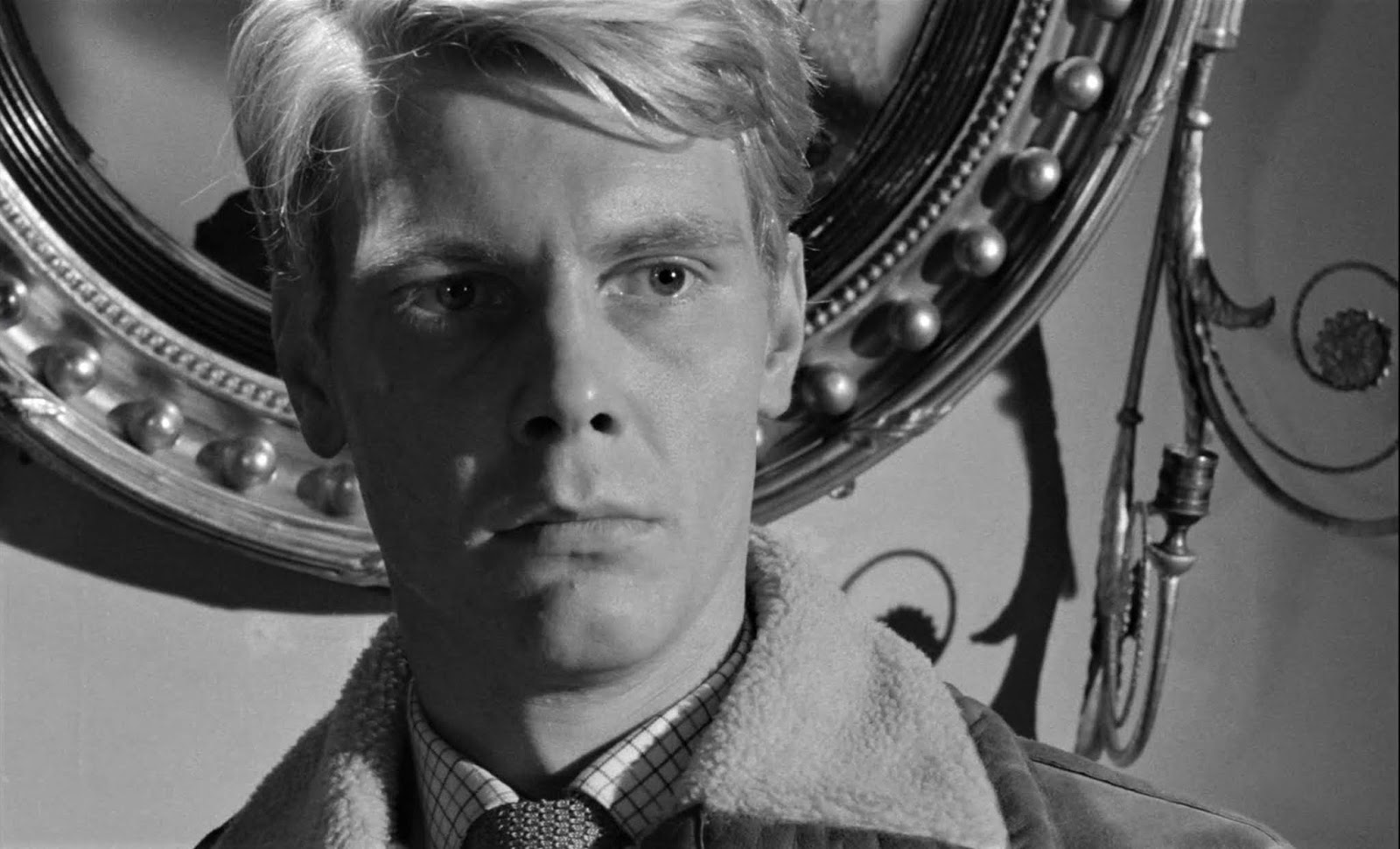 |
| James Fox as Tony |
 |
| Wendy Craig as Susan Stewart |
In The Servant, adapted by Harold Pinter
from the 1949 novel by Robin Maugham, Dirk Bogarde is Hugo Barrett, the devoted
and dutiful gentleman’s gentleman recently hired by aristocratic layabout Tony
(James Fox). Assigned to look after the daily creature comforts of his high-born,
high-maintenance master—"I’ll need,
well…everything! General looking-after, you know”—Barret is a live-in cook, housekeeper,
dresser, barman, decorator, and nursemaid. Which is a good thing, since Tony does
little but drift about imperiously giving orders in a bubble of lazy entitlement
that appears to have come built-in with his inherited Georgian townhouse in London’s
affluent Chelsea district, maintained on an independent income he
lives on while awaiting the materialization of an indistinct development job in
Brazil.
Barrett brings
eager-to-please efficiency and order to Tony’s world of self-absorbed disarray,
both men appearing to thrive under a mutually advantageous arrangement that sees each
contentedly assuming their clearly defined, socially assigned roles respective
of status and station. Considerably less pleased with this
alliance is Susan (Wendy Craig), Tony’s upper-crust, frostily snobbish fiancée.
She and Barrett take an immediate dislike to one another, she mocking his
genteel pretensions (white serving gloves) and lowbrow contributions to the décor
(“Tomorrow I’ll organize a proper spice
shelf for the kitchen”), Barrett resenting her intrusion into what he has clearly
come to regard as his territory.
 As per the presumptive
tradition of the class system, Tony and Barrett’s master/servant relationship bears
the surface characteristics of polite decorum, but Losey’s sly camera—always lingering
on faces a second or two after you’re sure a scene has concluded—captures the reductive
(if not downright contemptuous) looks Barrett shoots Tony’s way whenever his master's eyes
are averted or his back turned.
As per the presumptive
tradition of the class system, Tony and Barrett’s master/servant relationship bears
the surface characteristics of polite decorum, but Losey’s sly camera—always lingering
on faces a second or two after you’re sure a scene has concluded—captures the reductive
(if not downright contemptuous) looks Barrett shoots Tony’s way whenever his master's eyes
are averted or his back turned.
To be sure, there’s
nothing unusual in an employee harboring resentment toward an employer, for Barrett has to endure the daily micro-humiliations of being condescended
to and ordered about with nary a please or thank you. But there’s a faint trace of maliciousness
behind Barrett’s gaze. Something hinting at a duplicitous nature which has viewers of the film asking of him “What do you want from this
house?” long before Susan combatively confronts him with the same question.
 |
| Confirmation that Barrett is indeed plotting some type of intrigue comes in the form of Vera (Sarah Miles), his teenage "sister" he has persuaded Tony to take on as housekeeper. A witty tip-off that Vera is not Barrett's sister but is, in fact, his lover, appears during their cab ride from the train station. Vera places her hand a little too high on Barrett's thigh, resulting in a most perceptible rise in Barrett's suggestively fondled umbrella handle. |
As deliberate deception gives way to coerced seduction, The Servant plays it cozy as to a motive for the couple’s charade. But what’s brought into far clearer focus is the way the unfolding of these events intensifies the repressed antagonisms and attractions already evident in the characters’ ambiguous, contradictory interrelationships. Ultimately,
as the anarchy of power-plays, class conflicts, and sexual
tensions come to overthrow the structured formality of the film’s early scenes, the
lives of Tony and Barrett become inextricably intertwined, their personalities
undergoing a transformation (or unmasking) that finds roles reversed and
the initial power dynamic upended.
WHAT I LOVE ABOUT THIS FILM
 |
| Inequity of Power |
WHAT I LOVE ABOUT THIS FILM
When the arts are controlled by the mainstream, marginalized artists are inevitably compelled to resort to coding when expressing the truth of their reality. For example, Queer coding permeates the plays of Tennessee Williams and remains a defining characteristic of the works of D.H. Lawrence. In a similar vein, the dualism dramatized in The Servant reflects the insider/outsider existence of its gay author, Robin Maugham, who wrote it when homosexuality was still an arrestable crime in the UK.
 |
| Tony and Barrett sexually commune with one another through Vera |
Prolific novelist Robin Maugham (the openly gay nephew of the deeply closeted writer Somerset Maugham) was a war hero, political diplomat, and lawyer who scandalized his aristocratic family with the homoerotic themes of his work. Keenly aware of (some biographers would say tortured by) the social duplicity that afforded him unfettered access to privileges due to his class yet simultaneously denied him basic freedoms due to his sexuality, Maugham’s work often dealt with characters struggling with opposing natures and splintered identities.


THE STUFF OF FANTASY
Playing a difficult-to-read character who calculatingly exploits his all-things-to-all people charm, I think Bogarde registers so persuasively in The Servant because at all times it feels as if the actor is navigating familiar territory. Indeed, in the 2008 book “Ever, Dirk: The Bogarde Letters” a note from Bogarde expresses the sentiment that while he would like very much to be, in real-life, more like the character he played in I Could Go On Singing (1963), he laments that he’s “Actually nearer Barret in ‘The Servant,’ which is why it was so easy to do him…people don’t realize.”
One of the
most commented-upon details about The
Servant—rumored to be a heterosexualized telling of an autobiographically inspired, near-blackmail experience Maugham had with one of his own servants—is the assertively ambiguous nature of Barrett and Tony’s relationship.

I've not read the source novel upon which Losey's film is based (Maugham has been quoted as not being very fond of Pinter's
adaptation), but it does a marvelous job of dramatizing the unique two-sided
existence Maugham must have lived as a member of England’s aristocracy encouraged
by family and propriety to keep an essential part of his personal life hidden.
In this way, The Servant shares the twinning quality found in the works of Edward Albee, William Inge, and the aforementioned Williams. On the surface, their works are about one thing (in this instance, a class-conflict drama about an ordered life thrown into chaos by the intrusion of a wily servant), yet at the same time, they transmit an entirely different message on a wavelength intended for those in the know. The Servant's second, subliminal theme plays as a metaphor for
the world of pretense, image,
desire, and detection that defined gay existence at the time. It's a fear familiar
to anyone who has ever felt it necessary to conceal their true nature from others: the fear that the potential intimacy and bonding with another holds the possibility of exposure and exploitation, resulting in that person having power over
you.

THE STUFF OF FANTASY
Three-time Oscar-nominated
Cinematographer Douglas Slocombe (Raiders
of the Lost Ark, Julia, and Travels with My Aunt) won UK’s BAFTA award
for creating what is a truly striking visual style for The Servant. Brazenly contemporary, the look is part British neorealism,
borderline expressionistic, and hovering somewhere around gothic surrealism. Slocomb’s
painterly compositions and expressive B&W cinematography create an atmosphere
of menace and conflict with every frame.
 |
| Underscoring themes of claustrophobia and entrapment, Tony's townhouse is used as an active character in the film. Frequently, characters are framed in ways emphasizing their emotional imprisonment. In this shot, a distraught Tony appears hemmed in by both the bars of the staircase and the frame of Vera's bed. That he is surrounded by her muscleman pinups hints that perhaps it's not Vera he's really pining for. |
 |
| As Tony and Barrett grow more interdependent, the house itself seems to get smaller...the walls and ceiling closing in on them. |
 |
| Convex mirrors (something of a staple in Pinter films)... do they reflect, distort, or reveal? |
 |
| Throughout The Servant, Barrett...figuratively or literally... always comes between Susan and Tony |
PERFORMANCES
I’m not particularly
familiar with the films of Dirk Bogarde’s matinee idol period (although I did
catch one of his “Doctor" series films, about which the only thing I remember
is thinking how much he resembled a young Desi Arnaz), so I was never able to fully appreciate the impact of his transformation from heartthrob to serious actor via films like The Servant and Victim (1961). Knowing Bogarde only as the intensely
compelling dramatic actor giving memorable performances in such superb films as Despair (1978), The Damned (1969), Our Mother’s House (1967), Darling
(1965), and Death in Venice (1971),
it’s really saying something that I consider his performance in The Servant to be his best.
 |
| Sarah Miles' Vera exudes a brand of sexy that can best be summed up as guileless guile |
Playing a difficult-to-read character who calculatingly exploits his all-things-to-all people charm, I think Bogarde registers so persuasively in The Servant because at all times it feels as if the actor is navigating familiar territory. Indeed, in the 2008 book “Ever, Dirk: The Bogarde Letters” a note from Bogarde expresses the sentiment that while he would like very much to be, in real-life, more like the character he played in I Could Go On Singing (1963), he laments that he’s “Actually nearer Barret in ‘The Servant,’ which is why it was so easy to do him…people don’t realize.”
Never an actor renowned for his accessibility, Bogarde is the master of the side-eye, knows his way around a double entendre, and is uncommonly skilled at exposing the art of concealment. The same could be said of Bogarde both onscreen and off. The King of Denial, Bogarde remained closeted his entire life, despite many knowing that the husband of actress Glynnis Johns left her for Bogarde and went on to live with him as his "manager" for 40 years.
One of the delights of The Servant is marveling in Bogarde’s depiction of Barrett’s effortless slides in and out of his Manchester accent, and contrasting his “on the job” fussiness with his louche demeanor when “off the clock.”
One of the delights of The Servant is marveling in Bogarde’s depiction of Barrett’s effortless slides in and out of his Manchester accent, and contrasting his “on the job” fussiness with his louche demeanor when “off the clock.”
 |
| Tony: (Interview question) Do you drink beer? Barrett: (Primly) No, sir. |
Like Anthony
Perkins, that other '50s closeted screen star/onetime teen pin-up whose guarded image was
changed (arguably, not always for the better) on the strength of a single
role, Dirk Bogarde turned equivocality into an acting style. The Servant was the second of five films Bogarde would make with Joseph Losey.
 |
| "I can still think of things that will please you, can't I?" |
As embodied by the performance of James Fox (granted an "introducing" credit in the film), the morally ambivalent Tony also carries about him a provocative air of sexual ambiguity. A characteristic of the slight, blond actor which would be mined to similar effect in David Cammell and Nicolas Roeg's brilliant identity-switch head trip Performance (1970). Fox is absolutely splendid as the self-indulgent idler who falls under the corruptive sway of his Machiavellian servant, displaying a considerable range of emotional vulnerability as he morphs from patrician parvenu to pitiable prisoner. Both Fox and Bogarde deservedly won BAFTA awards for their performances (Most Promising Newcomer and Best Actor, respectively).

THE STUFF OF DREAMS

The morally-soft, easily-corrupted classes like to see themselves as the builders, but their desultory, essentially parasitic existences prepare them for nothing. Least of all survival. We encounter it in daily headlines—the wealthy, even in a system rigged in their favor, find it necessary to resort to fraud and swindles to win elections or get their children into universities. When forced, out of necessity, to learn to look after themselves, it is inevitably revealed that the working classes...the servants, who are the builders, the creators, and the survivors. The only ones possessing actual skills.

BONUS MATERIAL:
 Harold Pinter, Nobel Prize-winning author, playwright, and screenwriter of The Servant, makes a brief appearance in a terrific scene that takes place in a posh restaurant where a quartet of couples engage in enigmatic games of one-upmanship and subtle power plays. (That's Pinter in the center with actress Ann Firbank of One of Those Things.) Pinter also wrote the lyrics to composer John Dankworth's (Darling) song "All Gone," sung by Cleo Laine on the soundtrack to The Servant.

Although I
think I’m not meant to, I like the character of Susan a great deal. At least
the side of her that reminds me of Leroy in The Bad Seed. She's the one character not taken in by Barrett's obsequious fakery (precisely why he sees her as a threat) and doesn’t
mince words about it. In a film populated with weak males, Susan may be an insufferable snob with questionable aesthetics, but her questioning candor is the closest thing to principle in Pinter's world. Wendy Craig's performance has such intelligence and depth that she makes the frosty Susan an unexpectedly affecting player in this power-play drama.
THE STUFF OF DREAMS
I loved The Servant the first time I ever saw
it, an opinion only reinforced by repeat viewings. To me, it stands as the masterpiece
achievement of Losey and Pinter’s three collaborations: Accident (1967) and The Go-Between (1971) complete the set.

The Servant explores the dysfunction, hypocrisy, and false
values behind master-servant, upper-class/working-class roles, and power
inequities. Late in the film, this exchange occurs:
“Don’t forget your place, Barrett. You’re
nothing but a servant in this house.”
“Servant? I’m nobody’s servant! Who furnished
the whole place for you? Who painted it for you? Who does the cooking? Who
washes your pants? Who cleans the bath out after you? I do! I run the whole bloody place and what do I
get out of it? Nothing!”
And there you
have the crucial nugget of truth that festers within the core of social class hostility; Barrett’s ruinous subversion is
possible because Tony and his kind don’t really know how to “do” anything. (A fact made embarrassingly explicit a while back when the world looked on as a certain reviled 72-year-old
public figure demonstrated a lack of familiarity with how umbrellas work).
 |
| "A weekend in the county. So inactive, that one has to lie down." - Stephen Sondheim Tony and Susan pay a visit to Lord and Lady Mounset (Richard Vernon and Catherine Lacey) in a brief but hilarious scene involving the confusion of the words gauchos and ponchos |
The morally-soft, easily-corrupted classes like to see themselves as the builders, but their desultory, essentially parasitic existences prepare them for nothing. Least of all survival. We encounter it in daily headlines—the wealthy, even in a system rigged in their favor, find it necessary to resort to fraud and swindles to win elections or get their children into universities. When forced, out of necessity, to learn to look after themselves, it is inevitably revealed that the working classes...the servants, who are the builders, the creators, and the survivors. The only ones possessing actual skills.
The saying
goes, "If you don’t have a seat at the table, you’re probably on the menu."
The Servant suggests that come the day the
dismissed and disregarded claim their place at the table, the bill of fare is likely to be all those who have erroneously assumed that to be waited on by another
human being is their birthright.

Dirk Bogarde and James Fox in a clip from "The Servant" (1963)
BONUS MATERIAL:


Copyright © Ken Anderson 2009 - 2019


